In one essential sense, a cold read is a parlor game, like charades or Pictionary, trivia, in which a group of players takes turns reading lines of a work of dramatic art. literary s a play aloud, without rehearsal (“cold”), just for the fun of it. Everybody plays (no audience), assuming roles at random, regardless of gender, age, or type; doubling up as needed, and swapping off to share the leads. We don’t “act”—that takes talent and training and weeks of rehearsal. Playing with words, however, is a pleasure in itself, which satisfies the second of Horace’s injunctions in his Ars Poetica that plays should both instruct and please.
The game is playing out a story by voicing getting to know a work of dramatic art by voicing the words of the playwright’s characters.
In another sense, a cold read is like like a book club meeting, only we explore a play aloud, together, in real time, and discuss it as we go. Novels are solitary, silent pastimes; plays are social events. Plays are novels with no narration, only dialogue, written to be spoken. Tailor made for quality time with friends.
Then there’s this: Throughout history, literary art has consisted of a trilogy of primary forms: Poetry, Prose, and Drama. Of the three, for the first two thousand years Western Civilization, Drama was the only form available to all but the very few who knew how to read. Most of what most people knew about the world and language art was thanks to actors playing parts and speaking the words and thoughts of dramatists.
Think about that. Not only were most people unable to read; there were also very few books to read until Gutenberg in 1492. Literacy came with Dickens and the Industrial Revolution, the rise of the middle class, and for about a hundred years prose fiction entertained the hoi polloi, with poetry reserved for highbrows. Poetry these days is mostly in the lyrics to our songs; prose is all the other words we read and hear, both fact and fiction (or fake news). Drama, sadly, doesn’t resonate the way it did before the movies and TV—both focused more on pictures than on words.
Dramatic literature is indeed intended to be played on stage, and since most Americans rarely (if ever) see live theatre, it’s hardly likely they read plays. It is, nonetheless, worth noting that five of Aristotle’s six Elements of Drama—Plot, Character, Language, Meaning, and Tone—are manifest in the dialogue. Only Spectacle—the scenery, costumes, makeup, properties, lights, and effects that make a “show”—demands a stage.
There are so many reasons, from simple unawareness (“who reads plays?”) and all our countless other pointless pastimes to the cancer in our culture that derides and stigmatizes Theatre: The Wholly Human Art. *** “But plays are written for the stage!” you say. (Yeah, right. And who goes to the theatre?)
All these lame excuses are examined and debunked by CR/I and countered by as many more profound and startling arguments in favor of this amazing game (see Why Read Plays?)
***
Here’s Where Things Get Sticky
The rest of this long page is a hodgepodge of random thoughts I’ve dropped here, who knows when or why. Most of it’s already in the body of the blog, in different words, with more detail. Other bits attempt to condense that body into a digestible manifesto.
In its simplest and most flexible form, the game begins when someone (anyone) calls places, names the play, author, and the cast of characters, the setting, and opening stage directions. Then someone else—anyone, regardless of gender, age, or minority type—reads the first line of dialogue and assumes that role; another anyone reads the second line and does likewise. They read back and forth until another character appears, read by anyone else, and so on, doubling up for crowd scenes and swapping off to share the major roles.
Anyone can interject at any time to ask a question, make an observation, share a thought—start a conversation. At some point someone reads the next line in the script, and we continue on. If time runs out (as it often does) we set a time to finish (or learn what happens on our own).
It’s Fun. (It is a “play.”) It’s very easy. It doesn’t take much time—novels can gobble up days. There’s no prep or cleanup. And it’s absolutely free.
When you add in all the personal, social, and cultural benefits one gains from reading plays with friends, one wonders why so few of use—one in more than a thousand adult Americans—ever do it. Three out of four read at least one book a year. Why not plays? Who do you know that reads plays?
I’ve been doing it at least once or twice a week for over a dozen years.
Until the COVID-19 plague, we met all over town, in living rooms and coffee houses, theater lobbies, galleries, pubs and diners—anywhere that was comfortable, without a lot of noise, and few distractions. We can’t do that now.
What we can do, thanks to ZOOM and its competitors, is gather in chat rooms, face-to-digital face, online—which which lets us read with friends in far-off places.
Cold Reads on Facebook
To expand the scope of the game, I recently created CR/I on Facebook , a companion to this blog, open to the world at large for the sharing of thoughts and doings, interacting with others who read plays (we are so few), and eventually launching a cultural revolution.
I also created the Cold Reads/Online Facebook group to take advantage of the new technology. Membership is open, free of charge, to likely readers anywhere in the world, any one of whom can post Cold Reads events and invite their Facebook friends.
Strong Points
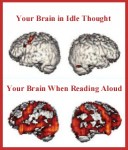
My quick overview begins with a startling discovery . Did you know that Science proves beyond all doubt:
After all, what is a play? a novel with no narrative—just people (characters) engaged in conversation (dialogue).
It’s FUN!
A cold read is a parlor game, like playing cards or Clue. We play (a play on words) a play; we read the lines we’re dealt, in turn, to tell ourselves a story. As we read, we talk about it and ourselves, the world—we socialize. Sometimes we’re hilarious, other times profoundly moved. Like any game, the more we play, the better we get. Unlike most, nobody loses; everybody wins.
It’s Easy
Anyone can cold read anywhere, for twenty minutes to three (or more) hours, with any one or two to a dozen friends (or total strangers)—all it takes is a digital reader. Simply download a play and start reading. Tips and guidelines on selecting plays, acquiring scripts, and gathering a group are posted in How It Happens, along with protocols for convivial reading.
WE DON’T ACT, although can be fun to play with words. Acting takes talent and training and weeks of hard work. We simply read, assuming roles regardless of gender, age, or type, and double up for crowd scenes, swap around so everybody reads the leads. WE INTER-ACT. Now and then we stop and reflect, recap, share insights. socialize. If time runs out before the end, we set a time to finish (or see how it ends on our own. WE DON’T REHEARSE. We read “cold,” finding out what happens as we go. WE DON’T PERFORM. It’s only us; no audience. No stressful stage fright. NO PREP, NO CLEAN-UP. All you need is a tablet, phone, or laptop to acquire and display the script. Online readers will also need access to the designated chat room.
And That’s Not All
Cold reads enhance our lives in many very different ways. We exercise and improve our reading skills, enunciation, conversation, as we come to appreciate literary Drama (Poetry and/or Prose as dialog) and develop a deeper understanding of ourselves and humankind. By doing it together, we share a common literary bond. We exercise our collective imagination, gain insights into other times and places, walk in other people’s shoes, and discover that playwrights are as literary, wise, and witty as novelists, as lyrical and profound as poets, and we take pride in dropping their names at parties. We Know Drama.
The Time was WHEN
For the first two thousand years of western civilization, most people couldn’t read. Anything they knew of the world they learned from personal experience or word of mouth, from priests and criers, politicians, storytellers, troubadours and minstrels, poets, and—by far most popular and influential—actors on a stage in plays by Sophocles and Shakespeare. The profound and lasting impact of live theatre on the world we know is addressed in The Wholly Human Art.
The Time is NOW
For the first time in human history, reading plays aloud in groups is free and easy, thanks to the internet. Think about that. (See E-Reading.)
Poetry, Prose, and Drama
Plays are one of the three main forms of literature. Until the Industrial Revolution (c. 1760-1840) they were the only form most people knew. Then paper mills made paper cheap, people learned to read, and Dickens wrote romantic novels (in prose), which they enjoyed at home—often read aloud, to the family, But they still went to the theater for Drama. Why read plays? They played parlor games instead, read poetry and prose. Then the movies came along, and Drama fell by the wayside.
Most of what we read these days is prose; poetry is rarely read but omnipresent in our ears (song lyrics), but unless we go to the theatre (and we don’t), We Don’t Know Drama.
The Issue of Time
Start out with 10-minute play; work up to one-acts. Most contemporary full-length plays run roughly 90 minutes, Add 30-60 more for intermittent conversation and a wrap—two and a half hours, in and out. Shakespeare, on the other hand, can take three hours just to read, in which case we set two dates and times.
It’s All Inside
This site explores these and other personal and societal benefits of reading cold in Why Read Plays?). If you need more convincing, start there.
About Us explains exactly who we are, what we do, and how we do it (with lots of options), and it urges people everywhere to do likewise—download scripts from our growing catalog, post feedback, and join our revolutionary grassroots movement.
Tabs beneath the banner at the top of every page open pages that address the topic; hover over the tabs to reveal sub-topics. Internal links, Categories, Search, and other functions are addressed in Navigation Tips.
So Do It!
Just for fun, if nothing else. If you like it, do it again (and again). You owe it to yourself to give it a try.
And after you read, if you have time, post us some Feedback.
I would like to start a group (club). On the Clubhouse app based around this concept and I would love to have you as a Leader/Administrator/Moderator in it. If you’re already on CH just search for me by name, Hillary Marek and send me a msg so we can talk about it in more detail. If you’re not on the platform yet just email me and I’ll send you an invitation.



 Cold Reads/International
Ok
I would like to start a group (club). On the Clubhouse app based around this concept and I would love to have you as a Leader/Administrator/Moderator in it. If you’re already on CH just search for me by name, Hillary Marek and send me a msg so we can talk about it in more detail. If you’re not on the platform yet just email me and I’ll send you an invitation.