Cold Reads International (CR/I) is—potentially—a world-wide pool of ordinary people (including you) whose only common bond (aside from being human) is our mutual regard for Drama, the Cinderella stepsister of Poetry and Prose, the third leg of the literary stool.
I say “potentially” because so far it’s only me and the few hundred people who over all too many years have read with me, a few at a time, some just once or twice, others once (or twice) a week (or month) for years (or now and then, once in a blue moon). We peaked as a local face-to-face group in 2016, when we read all the plays that won the Pulitzer Prize for Drama.
My grassroots movement pipe dream hasn’t happened.
I’d imagined never got off the ground.
It’s several hundred over the past few decades
We find the Plot and Character, the Language, Meaning of the play, and its aesthetic Tone—these five of Aristotle’s Six Elements of Drama—in the the playwright’s words. (The sixth is Spectacle—actors in costume and makeup, with scenery and properties, lights and sound—the magic that turns Drama into Theatre.)
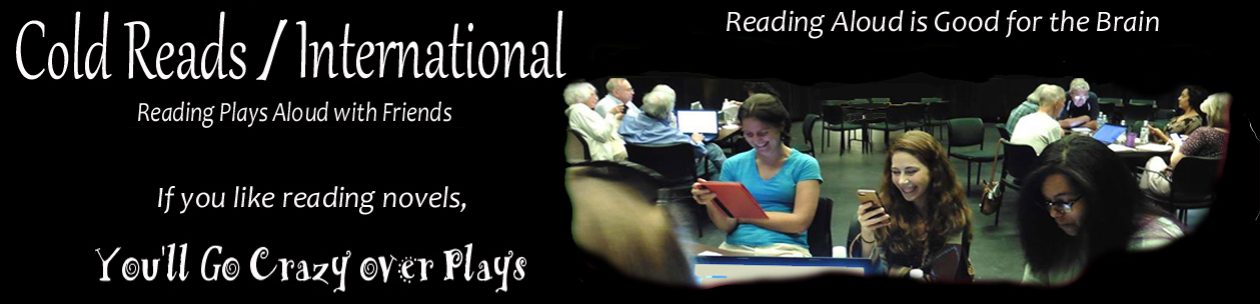
We gather in small groups—in person or online—to read stage plays aloud, for fun and satisfaction.
For no one but ourselves (no audience). Everybody reads, taking roles regardless of age/sex/type and swapping off so everybody gets to play.
We don’t rehearse. We learn what happens as we “cold” read— like a novel in dialogue.
It takes a little well-spent time—typically two or three hours, more or less depending on the play and how much we digress. Much less that most novels.
And it’s absolutely free of charge.
For simple-minded fun, if nothing else. (There’s so much else; see Why Reads Plays?)
Our Mission
is to reacquaint the world with the plethora of pleasures and benefits of dramatic literature as a game (a play on words) into the veins of our post-modern world. More to the point, we call attention to the forgotten form of literature—its Drama.
Throughout history, literary art has consisted of three fundamental forms: Poetry, Prose, and Drama. Of these three, for the first two thousand years of Western Civilization, only Drama was available to the overwhelming majority of humankind, all but the very few who of whom could read. Most of what most people knew about the world and language art was thanks to actors playing parts and speaking the words and thoughts of dramatists.
Think about that.
Not only were most people unable to read; there were also very few books until Gutenberg in 1492. Literacy came with Dickens and the Industrial Revolution, the rise of the middle class, and for about a hundred years prose fiction entertained the hoi polloi, with poetry reserved for highbrows. Poetry these days is mostly in the lyrics to our songs; prose is all the other words we read and hear, both fact and fiction (or fake news). Drama, sadly, doesn’t resonate the way it did before the movies and TV—both focused more on pictures than on words.
Drama as a form of literary art is (and has forever been) on the verge of obscurity. We note that for the first two thousand years of western civilization most people couldn’t read; so what they knew of the universe came from plays written by the best minds of their times. Only after Gutenberg were copies made, and not so many then. Only 750 were printed of Shakespeare’s First Folio (1623). It took popular demand for Dickens (and a rising middle class) to warrant tens of thousands. Only, he wrote novels. demand to read, hey heard from actors speaking wor
Our Vision
is a world in which most ordinary people are not only regular cold readers, but are also frequent patrons of (and participants in) a revived and thriving theatre, live on stage—for the sake of humankind.
Our Crackpot Dream
It starts with just two people reading a 10-minute play over coffee. It’s fun, so they do it again. And again. It gets to be a habit. They do it with other people, who do the same. It spreads like wildfire. Some start reading longer plays, discover that dramatic art is literature, and form groups that gather regularly—like book clubs, only better.
As this grassroots movement grows, it creeps into the culture. Schools incorporate it into their curricula, not only as dramatic literature (at last, along with poetry and prose), but to improve reading and speaking skills, spark imagination, inspire creativity—reading aloud is good for the brain!
At some point, it gets to be more than our tiny staff and free (limited) WordPress blog can handle, and some benevolent foundation (or progressive government)—recognizing the value of Cold Reads to its constituency and the world at large—funds an institution to promote it to the masses. (Hopefully this happens before some corporate sleazeball finds a way to make it pay). In time it becomes our most popular national (world) pastime.
Meanwhile, cold readers spur an even greater movement to restore the Wholly Human Art of theatre, live on stage, to its rightful place among the building blocks of civilization, with well-trained actors playing well-made plays, where ordinary people, in affordable seats, find they get more out of watching plays than doing other things they do. New companies spring up like clover, with well-paid, professional talent, rivaling, then overwhelming sports and other less fulfilling pastimes. (Football is SO Last Millennium.)
The argument from there to how Cold Reads might save the world appears in Salvation.
Our Past and Present State
The first (and so far only) local affiliate is Cold Reads/Charlotte, the prototype for the movement, formed in 2008 by me, George Gray, and over the next dozen years read nearly 400 plays with any three or four to a dozen of its 250 members. (see Our History). I created this blog in 2014 to encourage other groups, but it’s attracted no attention: so far barely a handful of anonymous individuals has joined, not one of whom has published a post. It’s a puzzlement.
That said, I still believe the game makes sense, for all the reasons I put forth, and long to find like minds who’ll help me make it happen (see Our People).
Surely for all of us cooped up at home, a Cold Read online offers both escape from fear and boredom and face-to-digital-face communion with other human beings.
 Cold Reads/International
How do I get a password for cold read international
Hello April
You have my sister’s name.
You don’t need a password to follow and comment on CR/I. Passwords for play scripts are doled out, one by one, to anyone, pending feedback (see Request Password in the left sidebar). Would you like to become a member? See the Join Us tab.