Category Archives: Supplemental

Renaissance Drama

UNDER CONSTRUCTION 

From Erasmus to Victor Hugo

Shakespeare’s plays evolved from (1) Italian translations and imitations of Roman plays that copied the Greeks and (2) 500 years of indigenous religious plays, secular moralities, and lewd  farces. From the first he retained the useful conventions of the Neoclassical Ideal and Aristotle’s elements—the 5-act structure, dialogue in verse (frequently rhymed couplets), kings and heroes—and ignored those that retrained his imagination. His plays intentionally violated the unities of time, place, and action, mixed tragedy and comedy, with parallel plots and gruesome onstage murders. Indigenous medieval drama broadened his scope to include the wit and wisdom of the common man, who spoke contemporary prose (in words now archaic or extinct). What emerged is universally accepted as the best that ever was, and its challenges well worth the rewards.

Shakespeare’s plays, in turn, were imitated and adapted through the centuries that followed, whittled down from several hours to less the two; five acts to four, then three; now mostly two. His poetry turned to purple prose in the 18th Century and was condensed in the 20th, his lengthy, lofty language lost through generations to the Twitter limit of today. Nonetheless,  his lines (and those of the contemporary King James Version of the Bible) are quoted more than most of the others put together); his characters are models for our playwrights, and his plots and themes are universal.
 

Modern Drama

UNDER CONSTRUCTION

This post, when written, will begin with Ibsen and end with Albee.

Realism vs Anti-Realism

From the end of the Franco-Prussian War (1871) until the beginning of World War I, most of the western world was stable, peaceful, prosperous, progressive, rational, trusting in the future. Known in France as La Belle Epoque (in England, Pax Britannica; in the US, The Gilded Age), arts and science flourished, technological inventions flooded the patent offices, all funded by growth capitalism. For the upper classes, life was a bowl of cherries.

Continue reading Modern Drama

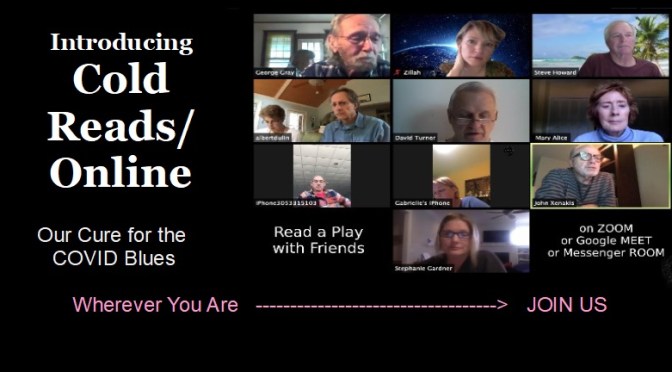
Meet Cold Reads/Online

The Game Changer

The purpose of this first mass missive is to promote Cold Reads as an answer to the monotony of these troubled times—thanks to my recent discovery of ONLINE VIDEO CHATS. They add a whole new dimension to the game—especially now, when all the things that usually gobble up our time are on hold. While we can’t be all together in one place, we can read face-to-(digital)-face with anybody—anywhere in the world, in the comfort of our homes. Continue reading Meet Cold Reads/Online

Cold Reads on Facebook

Starved for intelligent entertainment?

While we can’t all get together around a table, we can read face to (digital) face in a video chat room.  If you’re familiar with the technology, a chat room read’s the same as any other, as described in How It Happens. Continue reading Cold Reads on Facebook

COLD READS: the Film

Check out a short film by Cold Reader Albert L Dulin about why everyone in the Universe should read plays aloud, together!

COLD READS: THE FILM

To show our thanks, we’re happy to post Albert, to introduce you to him and promote his various livelihoodsplaywright, artist, musician, photographer, video producer, author of a recently published novel (Billie Heartwing).

MTA Post Mortem

Last Sunday I had the opportunity to present Cold Reads to members of the Metrolina Theater Association. We broke the ice by pairing up to read and ramble on 10-minute plays, then shared thoughts as a group. I talked for a while about how a cold read happens, referring to this web site; then we brainstormed on the reasons people do (and don’t) read plays. To wrap it up, the whole group started reading a full-length play we knew we wouldn’t finish.

A full account, including a transcript of my discourse, is posted on the Cold Reads blog. Continue reading MTA Post Mortem

MTA Event

On Sunday afternoon, October 12, I was invited to present Cold Reads to members of the Metrolina Theatre Association. Because I tend to ramble, I scripted the first half of of my presentation as follows, amended to suit a general (non-theatre) audience, with cues to prompt responses during the talkback.

I authorize and encourage (beg) anyone to use it as a guide to pitch the practice.  Continue reading MTA Event