When prehistoric people had no answers for natural forces that controlled their existence, they attributed them to the supernatural—super-human forces, gods—and began to search for ways to influence them, among which were music, song and dance, mimicry, self-sacrifice, epic stories, spectacle—all elements of theatre—which evolved into codes of religious ritual. So popular were these rites (and festivals) that they continued to be performed even after the mysteries were solved, at which point theater emerged as a separate entity.
DISCLAIMER: The following essay derives from what I’ve learned from life and what I’ve plagiarized from two primary sources: Oscar Brockett’s History of theTheatre, acknowledged as definitive, and The History of Theatre According to Dr Jack (Hrkach) online, along with countless multitudes of Wikipedia articles. I beg the authors to forgive me; if I live long enough, I’ll add a million footnotes.
This post, when posted, will explore the notion that most people are afraid to face themselves, and all the things we do serve to distract us from the recognition that, when push comes to shove, we’re each of us just human beings, one among billions, each of whom has cares and troubles, hopes and fears, friends and foes, sad or happy endings. Only theatre draws us into human introspection, lets us walk in others’ shoes. All other activity (except, perhaps, psychoanalysis) is an artificial attempt to escape, by focusing on something outside ourselves. Continue reading Dramaphobia→
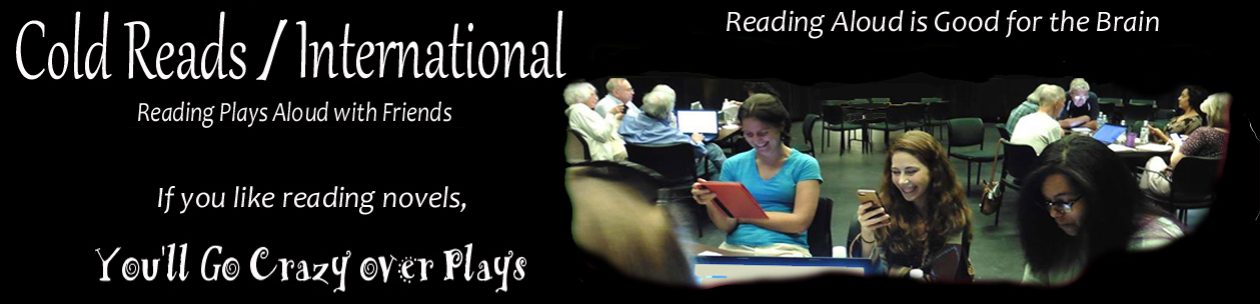
Last Sunday I had the opportunity to present Cold Reads to members of the Metrolina Theater Association. We broke the ice by pairing up to read and ramble on 10-minute plays, then shared thoughts as a group. I talked for a while about how a cold read happens, referring to this web site; then we brainstormed on the reasons people do (and don’t) read plays. To wrap it up, the whole group started reading a full-length play we knew we wouldn’t finish.
On Sunday afternoon, October 12, I was invited to present Cold Reads to members of the Metrolina Theatre Association. Because I tend to ramble, I scripted the first half of of my presentation as follows, amended to suit a general (non-theatre) audience, with cues to prompt responses during the talkback.
I authorize and encourage (beg) anyone to use it as a guide to pitch the practice. Continue reading MTA Event→
This post, when posted, will explore why those at the top do well to keep people away from the theatre when it doesn’t suit their purpose. The principle is divide and conquer, well described in depressing detail by Howard Zinn in A People’s History of the United States. Essentially, they divide the rabble into hostile factions, one a cut above the rest to keep the others out of sight and mind.
Underlying all the lame excuses for excluding plays from our post-modern lives is the intense love-hate relationship between most all religions and live theatre dating from the dawn of Western Civilization. Continue reading Thespis and Theocracy→