Under Construction
This page, when completed, will try to make sense of all that’s happened since the end of World War II.
Post-Modern Times
The Modern Age ended with an atomic bang that changed the balance of world power. America, having lost only lives and (evil) goods in the war, boomed big bucks, bombs, and babies, built skyscrapers, bought homes—our Golden Age. On the other hand, there were the Cold War and McCarthy, one a fearsome reality, the other a Trumpian conspiracy, both ever present in the minds of the population . To muffle these disturbing thoughts, they filled their lives with “things to do,” from work to play time—parties, ball games, hobbies, romance, movies and TV. Broadway grew into a giant industry maintained by repetitions and elaborations of financially successful (and increasingly spectacular) musicals and blockbuster quasi-realistic plays, extending Modern American drama far beyond its prime.
Conversely, Europe was in chaos—bombed-out buildings, refugees, ravaged landscape, economy in shreds, split in half by the Iron Curtain; the West dependent on American aid, the East conrtolled by the Kremlin. Its people, having endured the war first hand for the second time in twenty years, was destitute, demoralized, confused. Why did this keep happening? What did they keep doing that God let them keep on doing it? It didn’t make good sense. These questions led philosophers down the dangerous path that led to Existentialism, first and best expressed in the plays and essays of Jean-Pal Sartre (No Exit, 1944).
If God existed, these existentialists opined—if He even remembered His Creation—He had abandoned it to Darwin, Marx, and Freud—and to Nietzsche, who said He was dead. Or He could be crazy: capricious, arbitrary, infantile, alternately favoring and tormenting His creatures, demanding absolute faith in his Almighty Nothingness, teasing them with a mythical afterlife.
Whatever the case, they found no evidence that faith and prayer had any bearing on what happened in their lives or in the world. What people were, individually and globally, was up to them. They lived within (or without) the confines of society according to their personal moral and ethical standards. Right and wrong were relevant to circumstance, and frequently in conflict, but if people chose to use their heads and work together, there might be hope.
Two Paths to Recovery
Most Americans chose to keep believing in the Afterlife, professing faith in deities who, after all, “moved in mysterious ways” and “had their reasons”; “Ours is not to reason why,” while in their hearts they realized the world was dog-eat-dog and acted in their own best interests. Affluent, powerful, victorious, benevolent Americans chose to help restore Western Europe, build bombs to keep up with the Russians, engage the Korean War, embrace the military-industrial complex, and invent innumerable diverse products manufactured and sold by mammoth multinational corporations to millions of middle class consumers who, unless the were poor or black, were living the life of Riley.
They also took progressive steps to address issues in American culture, with legal and legislative reforms in human rights and privileges and tax-free endowments for the arts and sciences. By the mid-sixties, there were professional, non-profit theatres in 35 major cities nationwide, producing mainstream Broadway hits and revivals, new plays, the occasional classic. Add these to the New York originals, produced by venture capitalists for financial gain, and to these add the commercial touring companies, university productions, school plays, and the ubiquitous amateur groups in towns and cities nationwide to comprehend the scope of America’s Golden Age of Drama.
All that said, after movies, TV, and rock & roll, the audience was shamefully sparse: fewer than one in twelve Americans ever saw a play on stage. For the aging few who still attended more than one or two a year, it was as good as the mainstream gets, but theatre was a dying art.
Europe took a different route, and came up with the next historic Moment.
The Bottom Line
In 1965, the United States instituted the National Endowment for the Arts and appropriated $2,898,308 (just 0.003 % of a 93 billion dollar budget) for distribution among non-profit arts organizations and artists nationwide. State and local budgets followed suit with similar pittances. Otherwise the arts, like virtually everything else American, were up for sale.
Broadway was (and would remain) the primary source of mainstream drama, from which theaters elsewhere drew their repertoires. Essentially commercial ventures, backed by investors seeking profits, they produced what were sure to sell—mostly escapist musicals, sex comedies, and blockbuster dramas; Off Broadway struggled with experimental plays. The rest of American theatre, from school plays to regional rep, replayed and emulated them, subsisting on ticket sales, program ads, and the tax-free generosity of private foundation, institutions, and individuals.
It was hardly enough. For more reasons than this essay warrants, people stayed away in droves, and all these many institutions struggled to survive.
Europe, on the other hand, held fine arts in high esteem, and as each nation rose from the ashes and (with American aid) rebuilt, they carved enough enough from their budgets not only to fund world class national galleries, orchestras, dance troupes, opera, and theaters, but to subsidize them throughout towns and cities nationwide. In France, the Comedie Francaise was nationalized in Paris, one of twelve in major cities; in West Germany, where more that 100 theatres had been destroyed, most were rebuilt (with American aid), and by the 1960’s there were 175, of which 120 were state-owned and operated—as were all 135 in the East, including the preeminent Berliner Ensemble. This pattern applied all over the continent. Commercial productions were allowed, and many prospered, but state sponsorship was (and remains) the rule.
This difference in patronage affected the dramatic repertoire in two ways. At first, the European mainstream clung to the glorious culture of the past, producing the best of its oldies-but-goodies in the same old ways, more equally to please and to instruct, while America enjoyed her Golden Age. But soon the numbness of the war wore off, and as the nations reestablished order and united (in New York), creative dramatists experimented with new and different forms and styles, to come to the grips with the cosmic understanding that the only hope for humankind was humankind.
Indigenous Trends
Each movement was a radical departure from (or distortion of) dramatic realism, derived from the cultural tradition of its native land and reflecting its particular aftermath. In Germany, for instance, Bertolt Brecht’s expressionistic Epic Drama tore down Ibsen’s fourth wall to harangue the audience with caustic, sardonic parodies of mankind’s inhumanities (Mother Courage and Her Children, 1941). Russian plays devolved into unmemorable didactic anti-American propaganda, but England was awash with disillusioned, unemployed, disabled, shell-shocked veterans who found their voice in John Osborne’s Look Back in Anger (1956), which reduced life to the kitchen sink and defined a generation of Angry Young Men.
These and other revolutionary innovations burst onto their native stages; many worthy, some sublime, all out to save the godless world. All began in controversy and had their shining moments—some made history—but their form and content were rooted in native soil, and all were very different; few played beyond their borders. Over time most merged into the background (or the mainstream) with the times, but the best of their plays remain today in the standard repertory, and many others are worth knowing.
Theatre of the Absurd
Existentialists presumed the possibility of rational order, even if there was no God. There was a solution to every problem, a cause for every effect, only they could find them. On the brink of annihilation, their plays argued faith in human wisdom.
Other writers granted that there was no god, but denied that there was hope. Life was biology, zygote to grave, then oblivion; it had no meaning. The universe itself was deconstructing; earth was showing signs of decay brought on by human beings, who were disconnecting from each other and themselves, making love and money, digging ditches, building walls, fighting wars, polluting nature—and for what? None of it mattered in the end. A human being is just one of billions living on a smaller planet revolving around a minor star on the outer edge of a galaxy in the universe for three score and ten of its billions of years—what possible meaning could one have in the cosmic scheme of things?
This theory, first expressed by Albert Camus in his essay, “The Myth of Sisyphus,” (1942) pictured life as a boulder one pushed up and over a mountain, caught his breath and saw the world, imagined possibilities, then walked back down to do start all over. This mythic metaphor portrayed the history and destiny of humankind as painful, pointless, redundant, utterly absurd.
The first absurdist play to draw attention was Jean Genet’s one-act, “The Maids” (1947), about two housemaids who repeatedly rehearse a plot to kill their mistress, but can never manage to do the deed. Two years later, Eugene Ionesco, a Romanian living in Paris, produced “The Bald Soprano,” a pointless, plotless parody of middle class life with phrases drawn from basic language lessons repeated and modified with hilarious absurdities that deconstruct oral communication. Also in Paris (and writing in French) were Arthur Adamov from Russia, Fernando Arrabal from Spain, and the inscrutable Irishman, Samuel Beckett, whose first play became, in many minds, the best play of the 20th Century, and among the best ever written.
Moment #11: Waiting for Godot
The cradle of absurdism was the Latin Quarter, where its Bohemian novelty and radical ideas challenged the Parisian intelligentsia. The first play to receive international acclaim, in 1953, was so ironically simple and bewildering that no one could agree on what it meant—if anything. There was no plot, no dramatic conflict, no resolution. Critics were divided: it was either an inscrutable masterpiece or esoteric garbage. Audiences stood and cheered or left at intermission. The controversy led to productions elsewhere, with similar response. In England it was censored—almost banned—for “lavatory references,” while a one-night stand at San Quentin Prison (1957) stuck a familiar chord in 4,000 inmates.
Whatever the response, Waiting for Godot opened the gates for the flood of dramatists who found the world absurd, and explored new ways to expose, deplore, and ridicule it.
So what was all the fuss about? Here’s a quick synopsis:
Act One.
Two tramps wait by a single tree in the middle of nowhere for an unknown someone to appear. They engage in idle conversation, play games, complain of their ailments, reminisce, philosophize, ponder riddles, bicker, make up. Now and again one says, “Let’s go.” “We can’t,” replies the other.” “Why not?” “We’re waiting for Godot.” “Aah!”
A master passing with his slave stops off to rest, smoke a pipe, assert his awesome eminence, and rationalize his brutality, to the bewildered amusement of the tramps; he then continues on his way.
The sun goes down; the moon appears. A boy arrives to say Godot won’t come this evening, but surely tomorrow. “Well,” one says. “Shall we go?” The other replies, “Yes, let’s go.” [They do not move.]
Act Two.
Basically the same, with one exception: the master is blind.
One critic famously described the play as one “in which nothing happens, twice.”
Beckett
The Father of Post-Modern Drama studied French, Italian, and English Literature at Trinity College, where he assisted the impenetrable novelist, James Joyce, in assembling the baffling Finnegan’s Wake—which inspired and profoundly influenced his own early works, beginning Murphy (1938), in English; then Watt, Mercier and Camier, Molloy, Malone Dies, The Unnameable (1951-56), and How It Is (1961), in French—all critically acclaimed, but challenging to read. Colleagues knew him mainly as Joyce’s lackey until the mentor died in 1941; then as his successor.
By that time he was living in Paris under Nazi occupation, a courier for the Resistance, twice almost discovered by Gestapo. When his unit was betrayed, he fled south on foot to a village on the border, across which he smuggled guns, ammunition, and explosives, and completed his second novel. For his service he was awarded the French Croix de guerre and the Médaille de la Résistance.
An incident shortly after the war reveals the true depth of his character. One evening, while walking in the park, a stranger stabbed in the chest, a wound that nearly killed him. The assailant was apprehended, and Beckett asked him why he did it. “Je ne sais pas, monsieur. Je m’excuse.” (I don’t know, sir. I’m sorry.) Recognizing the ironic absurdity of the deed, Beckett refused to press charges, and the man went free.
While his novels and poetry had freed him from the Joycean shadows, it was Godot that made him, all at once, an international celebrity. A private person by nature and choice, he retreated from the limelight to write his second play, the apocalyptic Endgame (1956), another masterpiece on the futility of human life that, while critics put it on a par with Godot (“the greatest prose drama of the 20th century”), and Beckett considered it his masterpiece, it was but one of many plays by sudden multitudes of others who found meaning in their creations.
After Endgame, Beckett continued writing plays, most of which were short, some very short (Breath was timed at 35 seconds), experimental, testing the boundaries, outside the box. He also wrote plays for radio, TV, and one movie (Film, a silent solo featuring Buster Keaton), and published poems, stories, essays, and translations, the body of which earned him the 1969 Nobel Prize for Literature, but his lasting legacy, ironically, was that first play.
Best of the Rest
All at once the world became aware of the new philosophy, and playwrights everywhere, in their own creative ways, began writing works that dealt with people in a godless universe—among them Vaclav Havel, who later became the first President of the Czech Republic. In London, Harold Pinter and Tom Stoppard stand out; Roth Hochhuth and Peter Weiss in Germany; Max Frisch and Friedrich Durrenmatt in Switzerland; Ugo Betti in Italy; Slawomir Mrozek, Witold Gombrowicz, and Tadeusz Rozewicz in Poland—Gao Xingjian in China. In the former Axis nations, the typical theme was guilt, as docudrama; behind the Iron Curtain, veiled defiance. Pinter played with silence and a sinister sense of doom; Stoppard re-envisioned Hamlet.
Absurdist drama never was a conscious movement. The term was coined by Martin Esslin in The Theatre of the Absurd to account for all the different ways each playwright used to shatter established notions and sensibilities. There was no one the others copied; each play was unique. If as Sartre wrote, humanity is “condemned to be free” to choose, and if, according to Camus, life’s only meaning was one’s own; the sorry state of the world was the work of humankind. How one lived in it was up to the one, and nothing else mattered.
Playwrights chose to tear away at the manmade world with a broad variety of anti-Establishment plays that exposed, demeaned, and ridiculed its many faults and failings. To catalogue their distinctions is beyond the scope of this work. What matters (if anything) is that all were intended to shock their audience out of its post-war apathy with a stark exposure to the Human Comedy.
What matters even more is what came next.
The extent to which absurdist plays affected Post-Modern life is subject to debate. What must be clear by now is that most people who thought about such things (who weren’t in blind denial) had come to realize that life at best was up to the living, and were living accordingly. Some few (sociopaths) lived for wealth and power; some few (saints) lived for others. In between (but leaning to the right) the masses were left to choose where they fit in. If these plays didn’t cause these choices, the term became a slogan for our truly absurd post-modern age.
The American Dream
For middle- and upper-class white Americans, the ‘Fifties were Leave it to Beaver and “I Like Ike”—a dream come true indeed, after the Depression and the War. The rest had hoped for more. Black soldiers, for example, had expected the recognition and respect (and education, jobs) that white GI’s received. The Cold War flared up in Korea, and McCarthy played his Trump cards; otherwise all conformed to traditional roles. Men worked, women kept house, colored people “knew their place.”
In 1954, the U. S. Supreme Court ruled against racial segregation in public schools and drew attention to America’s fundamental flaw. By the early ‘Sixties, the Civil Rights Movement was in full sway and played out on TV. Southern Democrats became first Dixie-crats, then Conservative Republicans (once the party of Lincoln), and northern Republicans became Liberal Democrats.
In ’63, when MLK preached his American Dream and JFK was murdered, Betty Friedan published The Feminine Mystique to assert women’s rights; the next year Gay Rights societies picketed the White House, the United Nations, the Pentagon, Independence Hall; Viet Nam heated up in ’65; a year later old folks went on Medicare; ’67, Summer of Love; RFK, MLK, and Chicago in ’68, and in ’69 we landed on the moon. These and many other factors fractured the American Dream into competing cultural identities.
Likewise, the theatre broke from the past and exploded into a myriad of independent, experimental visions, all designed to startle, shock, titillate, amuse, outrage, enrage, and engage its dwindling audience, to wake it up to the the new reality. The best of these appeared not only in New York, but in theaters worldwide.
Within three years of its premiere, Waiting for Godot had become an international sensation. Originally played in the 74-seat Theatre de Babylone, it opened in New York on Broadway, in 1966, at the 800-seat John Golden Theatre, with vaudevillian Bert Lahr and method actor E. G. Marshall, directed by Herbert Berghof. People flocked from all around to see what all the fuss was about. Most walked away befuddled (or walked out); others argued over what it meant. Those who recognized its genius wanted more, and theaters Off Broadway, already producing off-beat plays, added Ionesco, Genet, Brecht, et al. By 1960, however, the only difference between Broadway and Off Broadway was seating capacity. Both offered top flight, risk-free, commercial plays and musicals that drew tourists from around the world, leaving the Absurdists to struggle on the fringe.
Off-Off Broadway
By this time New York was awash with young playwrights, actors, directors, designers, and technicians with Theatre degrees waiting tables and washing dishes, waiting for their chance. As the nation splintered and took sides, these thespians played for the love of it in intimate, unlikely venues, and came up with the latest, and likely the last great Moment in the history of dramatic art.
Off-off was born in 1958 at Joe Cino’s Greenwich Village, Beatnik-era Caffe Cino Art Gallery, 18 X 30 feet, with an 8 X 8 foot milk carton stage, audience standing; all plays under thirty minutes. $1.00 admission included coffee and Italian pastry. This concept quickly spread throughout the Village and into the boroughs, and within five years off-beat, off-off plays (capped at 99 seats) were receiving Obie awards.
The first successful American Absurdists were Edward Albee (“The Zoo Story” and “The Sandbox,” 1960; The American Dream,” 1961) and Arthur Kopit (Oh Dad, Poor Dad, Mama’s Hung You in the Closet and I’m Feeling So Sad, 1960). Others followed, mostly (as in the Latin Quarter) centered in Greenwich Village. Public recognition came in 1966, with Jean-Claude Van Itallie’s bombshell trilogy, America Hurrah.
La MaMa
The Heart and soul of off-off was the legendary Ellen Stewart, a fashion designer for Saks with no theatrical experience, who opened Café La MaMa in 1961, a combination coffee shop/boutique and—to support her young playwright foster brother—experimental theater. What the Public was to Off Broadway, La MaMa was to its little sister. Among the first and the only remaining original off-off house, it has presented more than 5,000 production in its several intimate venues.
By the mid-‘Sixties, roughly 400 plays by more than 200 playwrights were seen off-off, few of which were ever seen again—likely because the playwrights were green, the actors unpaid, seating limited to 99 fannies, and prices “what you can pay.” That said, from the beginning, there were those that made a difference, and as time went by, off-off became what Off had previously been to Broadway—a competitive alternative to the conservative mainstream.
The War in Vietnam
Much of what has happened in the world since World War II has roots in the utter absurdity of the “domino theory,” according to which any nation that fell under communist rule would topple its neighbor, who in turn would tip the next until the Soviet Union and (or) China ruled the world. The concept had its logic: Workers of the World Unite. Stalin had already swallowed half of Asia. Democracy had to take a stand, so when communist North Korea, backed by Russia and China, invaded the US-occupied South, Americans had no choice.
Or did they?
The Korean War was a 3-year standoff, curtailed to avoid nuclear holocaust. That should have been a lesson. The Bay of Pigs was an international embarrassment; the Cuban Missile Crisis brought the Cold War to the brink of fire and brimstone. Now this rebellion in Indochina.
To this day we’re technically at war with North Korea (on the verge of combat); Cuba remains an official threat to American national security. The overall effect of these disasters pales compared with Vietnam
A Little History
The tiny southeast Asian empire no one ever heard of had fought wars for independence since the Chinese took control in 111 BCE (BC to Christians), with very rare and brief success. The indigenous population of this thousand-mile sliver of mountains, then jungle, then coastal sand on the South China Sea won freedom only three times in a thousand years, for periods of fewer than fifty, until 905 CE—after which they lived in peace and war among themselves, a handful of independent dynasties disputing borders. Such was the case when Marco Polo visited both Champa and Đại Việt (South and North Vietnam) in 1288—their first exposure to the western world, and last for the next three hundred years.
By then, for context, Europe was out to conquer the world, with colonies on four continents. It was also on the verge of the Thirty Years War (1618-48), the last and most horrific religious war of the Protestant (since 1517) and Counter (1563) Reformations.
In 1616, Portuguese (Catholic) and Dutch (Calvinist) explorers sailed around the Cape of Good Hope to plant their flags in the south and north, respectively, to pave the way for history. In no time, ships were arriving in waves, with merchants trading trinkets for treasures, pioneers, soldiers to protect them, and Christian missionaries out to save and civilize the savages. All this sound familiar?
By this time, two opposing dynasties controlled the divided land—the Trịnh in the north, Nguyễn south—and the Europeans joined the fray on opposing sides, both nations contemplating colonies. But constant warfare wasn’t what they’d bargained for (this one lasted 45 years), and within a decade they gave up and went home, leaving only a handful of Jesuit priests to spread the love of the Lord.
The 18th Century was relatively peaceful, two independent Vietnams coexisting and going separate ways. The Trịnh created centralized government offices and introduced printing, currency, weights and measures; Nguyễn lords continued their expansion south to include the Mekong Delta. In the meantime, other Europeans came to trade, convert, and mingle with the population. Jesuits were joined by Dominicans, Augustinians, and Franciscans, to spread the word of the One True God; French and Spanish soldiers both protected them and joined opposing sides of their wars; while merchants sold western goods and customs to the ruling classes of each.
At first the natives—enlightened Buddhists and Confucianists—tolerated the strange culture; the Christians, on the other hand, denounced their ancestral faiths, and as the number, wealth, and power of the intruders multiplied and more and more of their own converted grew rich, and adopted western ways, native warlords saw the writing on the wall. In 1802, Emperor Nguyễn Ánh, the first George Washington of Vietnam—with the help of France—destroyed the Trinh and combined Champa and Đại Việt into a single nation for the first time in its history, renamed Vietnam by Ánh himself, now called Gia Long.
Immediately he turned against his foreign allies with a “closed door” policy that brutally suppressed Catholicism, burning churches and slaughtering their parishioners. Retaliation followed, which caused more uprisings, escalating over the years until the Spaniards, who had far more pressing problems at home, withdrew, forcing hundreds of thousands of native converts and priests to flee southward to the relative safety of French Cochinchina.
The Nguyễn family remained the indigenous emperors of Vietnam throughout the 19th Century, rising up against or collaborating with the French, until the Empire was dissolved in 1945 by Ho Chi Minh.
French Rule
Uprisings generated reprisals, massacres, retaliations, incessantly, until 1858, when Napoleon II sent gunships and soldiers to settle the matter once and for all. Within seven years the Mekong Delta became the French Colony of Cochinchina. By 1887, France ruled not only the whole of Viet Nam, but Cambodia as well, and six years later, Laos, all balled up together as the Colony of Indochina.
Over the next half century, the whole of Indochina was split among three feudal groups: French Catholics absolutely ruled; converted natives did their bidding for land and status; and an overwhelming (90%) majority—landless Buddhists and Confucians, exploited, demeaned, and abused—rose up in arms again and again, without success.
It’s most ironic that after a thousand years of Chinese domination and nearly another thousand fighting among themselves, the moment the nation’s united and free, the French take over; the boulder rolls down the hill, and resistance resumes.
It’s also worth noting that it’s all about religion, power, and greed.
Ho Chi Minh
The Father of Post-Modern Vietnam, born Nguyễn Sinh Cung, was the son of a Confucian scholar, a Mandarin magistrate who taught his sons religion, but had them schooled in French as well—until the Catholics demanded his conversion. His refusal led to the confiscation of all his possessions, and his family joined the 90%. From the pain and anger of this moment came the man who would lead his people to victory over three of the greatest nations in the world.
In 1911, with no prospects at home, the 21-year old scholar, now called Nguyễn Tất Thành signed on as kitchen helper on a French steamer and set out to investigate the western world (the enemy), get to know the people. After a month in France, he sailed for Boston, where he worked as a baker for a year; then to London, pastry chef; back to the States, menial jobs; back to England, dishwasher; all through the First World War—all the while absorbing the strengths and weaknesses of Western ways, embracing its democratic governments, but rejecting economic capitalism.
At the war’s end, he sailed back to France to join a socialist group of Vietnamese patriots at the Versailles peace talks, where the victors were carving up the map of the world. Encouraged and inspired by Woodrow Wilson’s Fourteen Points, they wrote letters to all the Great Powers petitioning for independent government and inclusion in the League of Nations, citing the Point that provided for self-determination. The failure of even one to respond outraged the Vietnamese. In retaliation, Thành published the letters under under the pseudonym Nguyễn Ái Quốc, and under that name he grew in stature to became a founding member of the French Communist Party.
One can but wonder what the world would be if only Woodrow Wilson had been wise enough to grant him an audience. Of all the far too many horrible and grave mistakes over the next two decades, this first snub was a lulu.
In 1923, as Quốc, he traveled to Moscow, to see how the other half lived. For two years, he studied at the Communist University of the Toilers of the East, and first employed by, soon high-ranking member of the Communist International, participating in the Fifth Comintern Congress, before removing to Canton, China, to indoctrinate and organize a communist community among the Vietnamese expatriates and refugees—until the Nationalist Chinese Kuomintang closed in, forcing his return to Moscow in 1927.
The next year he traveled, back to Paris, then to Brussels, Berlin, Switzerland, and Italy, learning languages, using over a hundred pseudonyms, speaking for the Comintern—organizing (causing trouble); finally sailing to Thailand for a year, then India, then Shanghai, where he was arrested, tried, convicted, sentenced, and reported dead in 1932. In fact, he was allowed to escape to Moscow, where he studied and taught at the Lenin Institute for six academic years.
In ’38, he returned to China, serving both as senior Comintern agent in charge of Asian affairs and as advisor to Chairman Mao’s armed forces in the Chinese Civil War. More importantly, he organized a group of ex-patriot Vietnamese revolutionaries that later morphed into the Viet Minh. He was there when the World war II began.
World War
Traditional historians maintain the War began with the German invasion of Poland, September 1, 1939. In fact, according to post-modern scholars, it started in ’31—barely a decade after the end of the “war to end all wars”—when imperialist Japan invaded China and occupied Manchuria. This led to the Second Sino-Japanese War in 1937, with both the Soviet Union (then allied with Germany) and the United States supporting China, albeit for opposite reasons.
Meanwhile, since its 1912 inception, the nationalist Republic of China, had been at war with Communists—Soviet Russians from the north and revolutionaries within. The Soviet goal was Chinese communism, their puppet leader Mao Zedong; the anti-communist Republic, led by Generalissimo Chiang Kai-shek, enjoyed United States support. An early skirmish in the pending international Cold War.
After Poland, Europe waited through nine months of pregnancy (the so-called “Phony War”) until May, 1940, when German Nazis overran Belgium, Luxemburg, The Netherlands, and—with Italian Fascist forces from the south—France. Four months later, Japan, to blockade Chinese shipping, broke an agreement made with pre-Vichy France and invaded Indochina, taking the port city of Haiphong in northern Vietnam. This action clearly allied Japan with Germany and Italy, enemies of France, and two days later, September 27, 1940, representatives from all three signed the Berlin Pact that united the Nazi, Fascist, and Imperialist nations as the Axis Powers of the war.
Strategic and political factors delayed the Japanese advance nine (likewise pregnant) months, until June 22, 1941, when Hitler broke his pact with Stalin and launched an all-out invasion of Russia’s western front. The sudden evacuation of Soviet troops prompted the Land of the Rising Sun to follow suit. Six days later Japan bombarded southern Vietnam, forcing the French Colonial Army to surrender the whole of Indochina, now owned but not occupied by Germany, its ruling French minority uncertain, under Japanese and Vichy French control.
This victory, however, was only a prelude for the December 7 surprise attack on Pearl Harbor, drawing the United States into the conflict, both in Europe (and North Africa) and the East. Now the war was truly global.
War in Southeast Asia
The Chinese Empire, ruled by the Qing family for 650 years—the last of barely a score of continuous dynasties in a chain that began in the Third Millennium BCE—came to an end in 1912, when nationalist revolutionaries, with the support of the UK, the US, Germany, Russia, Japan, and France, overthrew the Qing and established the Republic of China.
The leader of this Chinese Revolution was Sun Yat-sen, a physician, philosopher, and freedom fighter whose goals were independence, democracy, and socialism. Educated in Japan, Hawaii, and Hong Kong, a converted Christian and fierce proponent of modern (western) ways, he petitioned the Qing in 1894 to institute reforms, and when he (like Ho Chi Min) was snubbed, he founded the Revive China Society. The next year he led an uprising in Guangzhou (Canton), which sent him into exile.
He spent the next ten years in England, the United States, and Canada, raising money and support for his first two goals; then in Thailand, where he organized the revolution. In 1905, he created a secret society of rebel groups (the Tongmenghui) that instigated nearly fifty uprisings over the next six years and forced the last Qing emperor to abdicate in December, six years later. On New Year’s Day, 1912, he became the Father of the independent, democratic Republic of China.
Sun’s third goal was a socialist society, and he turned to the fledgling Union of Soviet Socialist Republics for recognition and support. In 1923, he aligned his National Revolutionary Army with the Chinese Communists and sent his protégé, young Chiang Kai-shek, to Moscow for several months to study the aftermath of the 1917 October Revolution. By this time the Russian Reds were winding up their bloody four-year Civil War against the Whites, leaving the Red Army free to help Sun wipe out the last of the Chinese warlords.
Chiang Kai-shek
Sun’s protégé and second in command was a 25-year-old Confucian warrior trained and schooled in Japan, who led a regiment against the Qing and became a founding member of the Kuomintang (KMT), Sun’s political party. But his visit with the Bolsheviks had revealed to him the flaws in the Soviet system, and two years after Sun’s 1925 death—as soon as all the war lords were subdued—Chiang took control of the KMT, severed ties with Moscow, outlawed Chinese communism, and began a purge that executed 300,000 actual and suspected Party members in 1928 alone.
His nationalist government was democratic in name only. Corrupt and greedy, packed with KMT and criminal gangs, it catered to the wishes of the Generalissimo, its prime objective to exterminate all communists, who had begun fighting back. Even after the Japanese invaded in 1931, he chose to wipe out enemies within and lost Manchuria. When the Second Sino-Japanese War broke out in 1937, he was forced to rush (and fail), despite vastly superior numbers) to defend the border, falling back with a “scorched earth” policy, burning land and villages and leaving millions to die of starvation and disease. On one occasion, he destroyed the dams around the city of Zhenzhou to stall the Japanese and flooded the Yellow River valley, killing half a million people.
These atrocities continued on both sides into the Japanese Invasion of Pearl Harbor, when both joined the Allies, with Chiang supported by the West (primarily the United States), the other by the Soviets. The Civil War had to wait.
Mao Zedong
The Father of the People’s Republic of China, born a wealthy peasant, well-read and educated, was moved by famine at eighteen to rebel against the Qing and march with Sun Yat-sen until the monarchy was no more, after which he returned to several schools, read Darwin, Marx, and Jefferson (among others), and became a history teacher.
He also joined the Chinese Communist Party and, in 1921, was one of thirteen delegates at the its first National Congress. He joined forces with the Kuomintang in 1924 to defeat the last of the Chinese warlords. But when Chiang Kai-shek outlawed the CCP in 1927 and began his purge, Mao broke with the nationalists and, in 1930, joined with other groups to form the Soviet Republic of China.
Thus began the Chinese Civil War, which lasted through the World War and ended with Chiang’s surrender of the mainland to the Communists in 1949.
At first the odds were heavily weighted in Chiang’s favor. His army outnumbered the Reds by more than ten to one, and thanks to them and the Russians, he controlled all but a few isolated, rural pockets of the country. In 1934, he surrounded these pockets with a million soldiers and lay siege, starving the insurgents and civilians until 90-100,000 rebels breached the blockades and retreated in the Long March, which fewer than 7-8,000 survived.
At this point, Mao assumed control of both the CPC and the Red Army and persuaded 50,000 rural peasants to join up, training them in guerilla warfare. But before the Civil War could resume, a greater threat forced them together to fight a common foe. The Civil War would have to wait.
The Second Sino-Japanese War
In 1937, a minor incident on the Manchurian border erupted into all-out war, and Japanese soldiers flooded south from Manchuria deep into China. Chiang’s forces rushed to defend against the Imperialist invasion, while Mao attacked their rear, in separate, uncoordinated campaigns.
Chiang’s millions of conscripted soldiers, poorly trained and ill-equipped, were no match for Japan’s disciplined professionals and mechanized weaponry, and he fell back with a “scorched earth” policy, burning land and villages, leaving millions to be slain by the invader or die from starvation and disease, or join the hoards of fleeing refugees, once fervent KMT supporters, who now held Chiang responsible. On one occasion, to stall the enemy advance, he blew up the dams around Zhenzhou and flooded the Yellow River valley, killing half a million people. Within a year he had surrendered all of north and much of central China and lost half a million men. Furthermore, in the wake of his retreat, millions of his people were left either to die at the hands of the Japanese—or from hunger and disease (or flood)—or to join the hoards of refugees, once fervent KMT supporters, who held Chiang responsible.
Mao, on the other hand, confused and demoralized the regimented Japanese with infiltration, sabotage, surprise attack, and ambush. Their exploits captured the proud hearts of the starving rural peasantry, the hoards of escaping refugees, and KMT deserters who flocked to him for refuge and became his followers. By 1938, his army was half a million strong, his popularity among the people expanding rapidly.
The war against Japan merged into the Second World War with the Invasion of Pearl Harbor, when both Chiang and Mao joined the Allies— one supported by the West (primarily the US), the other by the Soviets. The West officially recognized the government of Chiang’s Republic of China and declared him Supreme Commander of Allied forces in China, charged with defeating the Japanese and suppressing Chinese Communism. Moscow sent supplies and troops—and Ho Chi Minh—to bolster Mao, who used them against both Japanese and Kuomintang opponents. By the time Japan surrendered, Chiang’s army was in tatters, the Republic held up by western nations grown tired of war (his mostly urban following tired of him), trying to balance Chiang’s corrupt and criminal (but anti-Communist) government against Mao’s Stalinist Red Menace, liking neither, and coming up with nothing, chose to wait and see.
Meanwhile Mao continued to receive lavish support from Stalin, who needed a friendly China between Russia and the deep blue sea. Soviet state-of-the-art weaponry and troops flowed in, along with tested propaganda that spread among the rural peasants, villagers and farmers, preaching power to the people, calling them to arms. As soon as the World War ended, the Chinese Civil War resumed.
Better Dead then Red
In 1944, the US State Department persuaded Chiang, ruler of the recognized Chinese Republic, to allow American diplomats to establish contact with Mao’s revolutionaries—ostensibly to coordinate objectives in the war against Japan, but also to investigate the Communists politically and militarily to determine if the US would benefit from a permanent alliance (just in case the Reds won the Civil War). They reported not only that the administration was more “of/by/for” the people—and far less corrupt—than Chiang’s Nationalist-Republic, and that Mao’s Communism was more akin to European Socialism than Stalin’s Bolshevik regime. Alliance would further separate Mao from the iunfluence of the Soviets, and provide an eastern border to contain them. Their recommendation was an effort to unite the KMT and the CPC into one democratic socialist nation; failing that, their money was on Mao.
Alas, diplomacy lost out to American politicians, who delayed action until the World War ended, The Dark Side won out, and the last hope for a truly democratic, socialistic, modern—humanistic—Chinese society was dashed.
No sooner had the fallout cleared than the Civil War resumed, America again supporting Chiang, the Soviets backing Mao, until the Red Army drove Chiang and his remaining followers out of Mainland China to the tiny island of Formosa (now Taiwan) in 1949.
The Last Emperor of Vietnam
Since 1802, the indigenous Vietnamese had recognized the Nguyễn Dynasty as Emperors of Vietnam, opposing or collaborating with first French, then Japanese invaders. The last was Bảo Đại, a Roman Catholic schooled in France who inherited the Empire at 1925, at the age of 13, but remained in exile until his coronation in 1934.
A notorious westernized playboy, he took little interest in affairs of state, spending most of his time among celebrities abroad, leaving Communists and Frenchmen to fight the Japanese and themselves. But when the European Allies won back all they’d lost and were advancing on Berlin, Japan worried that Free France in Indochina would provide a base for Allied offensives. To solve the problem, they ousted the French regime in the spring of ’45, executed all the high officials, and coerced the popular Emperor into returning home to rule the age-old Empire as an independent state within the Japanese sphere of influence.
Three months later the World War ended, leaving the Emperor to face the Việt Minh with no resources or support. Never happy as a ruler, he was easily persuaded to abdicate in favor of Ho, who promptly dissolved the 2000-year-old Vietnamese Empire and declared the Democratic Republic of Vietnam.
President Ho
Seven months before Pearl Harbor, after thirty years abroad, the Comintern official Nguyễn Ái Quốc (using the name Hồ Quang) returned to his native land, changed is name forever to Ho Chi Minh (Bright Spirit), and set out to free his people—first from the ruthless Japanese, then the hated French. He organized the Việt Minh, a coalition of revolutionary groups, from among whom he recruited and trained an army of freedom-fighters, who fought for the Allies (including France) with secret logistical support from the U.S. Their exploits were equal to, if not far greater than those of their southern counterparts, given that the government of Indochina was then officially Vichy (Nazi) French.
The day Japan surrendered to the Allies (September 2, 1945), Ho Chi Minh read the Vietnamese Declaration of the Independence aloud to a massive crowd of exhilarated patriots in Hanoi. In a deliberate appeal for American recognition and support, the first sentence was a direct translation of its Jeffersonian document: “Tất cả đàn ông được tạo ra bình đẳng. Họ được Tạo hóa ban tặng cho một số quyền bất khả xâm phạm, trong số đó có Quyền sống, Tự do và theo đuổi Hạnh phúc.” (“All men are created equal . . . the pursuit of Happiness.”)
The French War
Three weeks later later Free French forces overwhelmed Hanoi and forced Ho the hills. The First Indochina War—known as The French War in Vietnam—had begun.
Within a month, however, more than 200,000 Nationalist Chinese (Allied) troops arrived to repatriate the defeated Japanese, and to force a fragile truce between Ho’s Communist Việt Minh and the Capitalist French. The agreement called for the resumption of French rule in Indochina, in violation of the principle of self-rule embodied in the Charter of the United Nations, signed by France and fifty other nations only three months earlier. Ho wrote repeatedly to President Truman appealing diplomatically for recognition of Vietnamese contributions to the war, inclusion among the United Nations, and support for the truly Democratic Republic of Vietnam in their fight for freedom. The President never replied, so Ho turned to Mao.
This has happened before.
The USA was all for Ho’s Democracy, but feared and hated Communism, no matter it’s apples and oranges: Democracy compares well to Bolshevik Dictatorship; Communism is the utopian alternative to dog-eat-dog Capitalism. The two opposing suddenly World Powers mixed and matched, both bound to fail. Ho’s Democratic Socialism made good sense. What went wrong?
In 1946, France officially reclaimed Indochina and installed a puppet regime in Vietnam, appointing as president Ngo Dinh Diệm, a dictatorial criminal whose wealthy noble family had been Roman Catholic since the French first arrived in Vietnam in the 17th Century—a slap in the face to the overwhelmingly Buddhist/Confucian population. These Catholic Vietnamese took the place of the French in the social order, owning all the land and money, purging non-believers—and Communists—and allowing multiple millions to live in poverty and die of hunger and disease in the wake of war.
The French War picked up where it left off, with minor skirmishes along the border until the French bombarded Haiphong Harbor in November, 1946, killing more than 6,000 civilians. Three weeks later Ho officially declared war on the (French) State of Vietnam and immediately began a guerilla campaign to overthrow the puppet (Catholic) state. His surprise attacks (like Mao’s) led to early victories, word of which spread all over the country—along with his promise of a better world through Marxist revolution. By 1950 his popularity among the peasant, non-Catholic masses was so great that France rejected a popular referendum to avoid the humiliation of an overwhelming defeat.
Foreign Intervention
The war itself was touch-and-go, with major gains and losses on both sides and tens of thousands dead, until 1949, when the Red China won the Civil War and Russia tested its first atomic bomb. Suddenly the Capitalist West woke up to the fact that a significant portion of the globe was under Communist control, and Vietnam became a factor.
Mao and Stalin weighed in heavily for Ho Chi Minh (who, after all, was a ranking member of the Comintern), while the U.S. secretly supplied the French, and the game changed. Although no foreign soldiers fought for either side, the Great Powers flooded both with light and heavy weapons, tanks and planes, and teams of technical, diplomatic, and military advisors that turned the war up several notches to the brink of international war.
America was opposed to the French in principle (its own freedom a product of British colonialism) and abhorred the feudalist corruption of the Diệm regime, but France was a European ally, and Ho’s rogue Democratic Republic of Vietnam (DRV) was Communist. Except for Korea Vietnam, and the Malay Peninsula, the entire east cost of mainland Asia mainland belonged to Mao and Stalin, whose goal was global. Already Russia had gobbled up its border states into the Soviet Union. Vietnam stretched 1000 miles from Hanoi, near the Chinese border, to Malaysia. If Ho Chi Minh won the French War, it seemed likely that his success would inspire communists already active in neighboring states. Laos, Cambodia, Malaysia—the whole of Southeast Asia could fall, one by one (like dominoes) under Comintern control.
From these musings came the infamous Domino Theory that became the Truman Doctrine, in which the United States vowed to protect the world from the Red Menace. In 1950, Truman increased financial aid and sent a Military Assistance Advisory Group (MAAG), a team of sixty military specialists, to assist the French in organizing and training the South Vietnamese Army. By 1954, while no American combat troops had set foot in Indochina, the United States had spent over two billion dollars in military aid—80 percent of the cost of the French War—which the French were losing..
Before its end, however, the Army of North Korea, backed by Russia, invaded its sister to the south, and Ho Chi Minh took a back seat to Stalin.
So began the (suddenly hot) Cold War in the east.
The Korean War
Stalin and Mao, flush with success, did indeed intend to communize the world, each in their way. For Stalin, the obvious starting point was Korea, under Japanese rule since the First World War, partitioned after the Second at the 38th Parallel—a Demilitarized Zone (DMZ) between the north, under Soviet protection, and the American controlled south. Already armies reinforced the border on both sides, and skirmishes frequently flared.
On June 25, 1950, one side (no agreement on which) fired shots that triggered a full scale invasion by the North Korean Army all along the line. Within two months they had driven their southern countrymen (and American advisors) south and east to pen them in on the tiny Pusan Peninsula, leaving the rest of the country under Communist control.
A month after that, however, General MacArthur launched a massive surprise attack on the west coast, recaptured Seoul, cut off and killed or captured enemy south of the DMZ, and began an invasion of the north that drove the remaining North Koreans to within 50 miles of the Chinese border.
At this point China opened the gates to hoards of Mongols armed with Soviet weapons, and Soviet jets shot rockets, pushing the ROK Army back down to the DMZ and prompted the United States to send massive reinforcements to hold that line for the next two long, cold years of bloody stalemate.
In the summer of 1953, an armistice between the US and North Korea stopped the shooting, but South Korea refused to sign a treaty. Ergo, ever since, a cease fire has existed in this never-declared and never-ending “police action.” America still had yet to lose a war.
That action did, however, demonstrate the military might and global intentions of the communists, which were magnified in the imaginations of Americans by politicians, preachers, and the movies, generating mortal fear and loathing among the American people, who built bomb shelters and learned to “duck and cover,” continually (subconsciously) aware that any moment might well be their last. Most were convinced by that Communists spies were everywhere, falsely and maliciously alleged by the fascist Senator from Missouri, Joe McCarthy.
While “Tail-gunner Joe” was censured and disgraced in in 1954, the damage had been done. From that time since, the very idea of Communism (or European Socialism) has conjured fear, suspicion, hatred, anger, and defiance in the vast majority of American people, and the Truman Doctrine remains at the core of US foreign policy.
The End of Indochina
Meanwhile, further south, the French War was winding down. France was under pressure to abide by the UN guarantee of self-rule and grant freedom to its Indochinese colonies; America slashed financial aid. Opposition on the home front grew as well, and French troops were homesick. In the spring of 1954, they suffered a crushing defeat at the Battle of Diem Bien Phu, and the French War stopped.
At the Geneva Conference that November, the UN applied the self-rule clause and abolished French Indochina, freeing the Kingdoms of Cambodia and Laos and dividing Vietnam at the 17th parallel (a la Korea) into two provisional, independent states: Ho’s Marxist Democratic Republic in the north, and Diệm’s State of Vietnam in the south. The agreement called for popular elections in two years to merge the two states into one.
It also allowed 300 days for people to move freely between Diệm’s capitalist Republic of Vietnam (RVN) and Ho’s socialist Democratic counterpart (DRV), prompting an estimated 850,000 Catholics pick up stakes and move south to Saigon. Buddhists, however, for the most part, remained in the south to become the insurgent opposition—the communist Viet Cong.
In the north, the Viet Minh began the process of government, instituting land reforms and rent reduction (and executing as many as 100,000 feudal lords), patiently awaiting the election, knowing they would win. The South, without the French, was falling apart.
In all 150 years of the existence of Indochina, French military policy allowed no native colonists to occupy positions of authority or voice in government. Not only were they considered inferior beings, incapable of self-rule; they were mostly Buddhists, in vehement opposition to Diệm’s rule. Consequently, the evacuation left Diệm with a leaderless army, a government with no expertise, and a populace alive with Viet Cong. He used what force he had (with weapons supplied by the U. S.) to put down insurrections and ruthlessly massacre thousands of Buddhists—who kept coming. Barring a miraculous intervention, the first domino would soon fall.
The American War
In 1955, President Eisenhower sent a MAAG group of 327 officers and men to organize and train the South Vietnamese Army and establish diplomatic relations with the Diệm regime. The job would not be quick or easy, given that Diệm’s army was composed of conscripted grunts who didn’t want to be there (as opposed to the ferocious zeal of the Viet Cong), and that he distrusted the Americans and ignored their advice.
The next year, well aware of the will of the people, he refused to commit to the agreed-upon elections and proposed negotiations that delayed proceedings for several years, while U. S. forces launched a massive, fatally flawed campaign to search and destroy the Viet Cong and win the people’s hearts and minds. North Vietnam protested these delays, but patiently endured, confident that when the time did come, the whole of Vietnam would be theirs.
The Ho Chi Minh Trail
Ho Chi Minh, aware as well of certain victory, was just as certain—based on personal experience—that the U. S. would likely go to war keep that from happening. He urged the Politburo to join the Viet Cong, overthrow the Diệm regime, declare one state, and send the Americans packing. The hope of elections put the plan on hold while Ho continued to demand a date (and secretly supplied the Viet Cong with Chinese weapons), but by 1959 all patience was exhausted. The North Vietnamese Communist Party approved a “people’s war” on the South, and Ho put his plan into action.
His ultimate goal was to capture Saigon. Once the Diệm Regime was overthrown, the Americans would have no choice but to recognize the will of the people. But Saigon was a thousand miles away on the Mekong Delta, at the southern tip of the nation. The Viet Cong controlled the countryside, but were losing the war in the cities, thanks to Diệm’s massacres and dwindling supplies. To invade from the north would devastate the land and decimate the population. Ho chose instead to strike at the hear and end it with one campaign.
To do this would require transporting munitions and supplies to the field of battle. Any route so long would be susceptible to air attack and sabotage; by far the least lay twisting and turning through the western mountains, under a canopy of trees, across the border in Laos—itself engaged in war against the U. S. backed Kingdom.
That spring, in collusion with the Pathet Lao (Laotian Communist Party), Ho’s People’s Army invaded and occupied eastern Laos and employed 30,000 laborers to transform 10,000 miles of ancient trails and footpaths into a highly sophisticated network of tracks, roads and waterways from Hanoi to Saigon. By 1963, 200 tons of supplies a day were being delivered to the Viet Cong, and 40,000 Viet Minh regulars had infiltrated their ranks to enhance and coordinate the insurgency.
JFK’s Bit of Blame
Since 1959, Viet Cong forces had swollen from a mere 5,000 to 100,000 strong, along with 40,000 Viet Minh, and had spread throughout the rural countryside, village by village, farm by farm, leaving Diệm virtually surrounded on all sides within the provinces around Saigon. The domino wat tilting left.
In 1961, President Kennedy, having failed to stop the Berlin Wall, lost the Bay of Pigs, and brought the world to the brink with the Cuban Missile Crisis, desperately needed a win. He increased military aid to South Vietnam from $28,000,000 to $144,000,000 and the number of MAAG advisors from 746 to over 3,400 (including the Green Berets). The next year he sent 11,000 regular Army troops to provide logistical (non-combat) support; by 1963, “support” personnel in aviation, communications, intelligence, special warfare, and logistic units reached a total of 17,068 men, of which 10,916 were Army.
During these years, Diệm continued to wage his hopeless religious war against non-Catholics, his criminal Gestapo torturing and killing tens of thousands and earning the hatred of tens of millions. America turned a blind eye until June 11, 1963, when a Buddhist monk burned himself alive on a busy Saigon street, a photograph of which circulated world-wide. At this, the U. S. began to entertain the thought of regime change, and on November 2, with approval from the CIA, Vietnamese generals overthrew the government and executed Diệm, his family, and his favored officials.
Three weeks later Kennedy was assassinated.
These murders left the both governments in chaotic disarray as generals and politicians fought among themselves and one another over policy and strategy, and the Viet Cong closed in.
The Johnson Escalation
President Johnson took office with high hopes for a Great American Society; but first he had to settle the Vietnamese conflict. His advisors pushed and pulled, either to withdraw support and let the chips fall where they may, or go whole hog, take over North and South, install a democratic, capitalist government, and save the world from Communism. Detailed preparations for either case were made, while a compromise offered billions of dollars in economic aid and diplomatic recognition if Ho stopped trying to overthrow the government of South Vietnam, warning him of “great devastation” from American bombing otherwise..
The tipping point was the false report of a North Vietnamese torpedo attack on the USS Maddox in the Gulf of Tonkin, August 4, 1964. This report was followed shorty after by several others admitting and explaining the mistake, but either the President didn’t get the message (intentionally withheld or lost in the Chain of Command) or he deliberately chose to ignore it. In either case, that very night he interrupted prime time TV to denounce the attack, and the next day he retaliated with Operation Piercer Arrow, a massive aerial bombardment of five North Korean ports that sank or crippled 29 North Vietnamese destroyers and wiped out 10% of the nation’s oil reserves. Only two American planes were lost; one pilot killed, the other captured, to become the first POW of the American War in Vietnam.
Two days later Congress passed the Tonkin Resolution, granting Johnson executive authority to escalate the conflict.
Ho Chi Minh recognized the Resolution as subtle declaration of war, the bombing its first act, and he responded with several success assaults on U. S. installations in the South. Johnson prudently (politically) withheld retaliation until after his ’64 election. Once secure in office, all he needed was a compelling provocation.
The War in the Air
On February 7, 1965—barely two weeks after Johnson’s inauguration (and during Soviet Premier Kosygin’s first state visit to Hanoi)—the Peoples Army of Vietnam (PAVN) attacked a U.S. Army base in Pleiku. Before that day was done, 49 sorties were bombing and strafing five strategic targets in North Vietnam.
Dubbed Operation Flaming Dart, it was a show of strength, a message to remind Ho that the South was out of bounds. Three days later Ho responded by blowing up a U. S. occupied hotel, killing 23 American soldiers. Johnson upped the ante with Flaming Dart II—twice as many bombers plus 33 jet fighter escorts; Ho struck back on the ground. The time had come for Johnson to make good on his threat, and he signed off on Operation Rolling Thunder.
Originally this operation, launched on March 2, was intended as an 8-week period of gradually increasing and intensifying bombing missions aimed at PAVN installations and supply routes in both North and South Vietnam (and Laos, and Cambodia), by which time the message would be more than clear and the U. S. could get back to ridding the South of the mushrooming Viet Cong. Air raids did the most damage with the least risk to American lives. No need to send in the Marines.
Meanwhile, however, China had secretly weighed in with a formidable defensive arsenal of guns and ammunition (artillery, tanks, rockets, missiles, MiG fighter jets) and thousands of noncombatant troops to serve behind the lines. Consequently, Rolling Thunder encountered heavy resistance and suffered considerable losses, which forced the U.S. to extend and intensify the eight-week operation, “bombing the [Vietnamese] back to the Dark Ages,” until November, 1968—almost four years—having flown over 300,000 sorties, dropping 864,000 tons of explosives on the North, and losing nearly a thousand planes—not to mention loss of human life on both sides.
And that was just the beginning. In April, 1965—just a month into Rolling Thunder—Operation Steel Tiger began, its mission concentrated on the Ho Chi Minh Trail; then Arc Light in June, Tiger Hound in December, all merged into Commando Hunt in 1968 and continued until, along with other short-term operations, ending with Operation Linebacker (May-October ’72) and Linebacker II (Nixon’s massive “Christmas Bombing” of Hanoi and Haiphong, Dec 18-29). Seventeen days later, in Paris, the Peace Accord were ratified by both sides, and the bombings stopped.
All told, in these eight years (’65-72) the U. S. dropped 7,662,000 tons of explosive, incendiary, and chemical bombs on Vietnam—more than three times as many as in all of World War II—and all for nothing, thanks to an endless number of soldiers and civilians who rebuilt as quickly as the bombs destroyed. The air war was a bust.
Boots on the Ground
Among Diệm’s last official acts was to yield control of the Vietnamese Army (ARVN) to the American Advisors, now strategically embedded in all regimental units. With the coup, however, government collapsed into one incompetent, short-lived coup after another, and people lost all hope. ARVN soldiers were reluctant, unwilling, often opposed to American training, and losing on the battlefield. When the People’s Army (PAVN) threatened the U.S. air base at Da Nang on March 8, 1965—just a month after Operation Flaming Dart—American helicopters dropped 3,500 Marines in to defend it..
While American troops had been deployed in South Vietnam since Eisenhower, their mission had been restricted exclusively to administrative, logistical, and air support. The Da Nang mission marked the first use of American combat soldiers on Vietnamese soil, and the never-declared American War unofficially began.
By the end of the year, 200,000 young Americans were killing and dying far from home, with more to follow. Four years later, at its peak, there were the number had risen to 543,000. Three years after that, all were withdrawn, and for the first time in history, not only was Vietnam an independent Socialist Republic, but the U. S. had finally lost a war.
By that time 2.7 million had served at least one 13-month tour of duty, 58,000 of whom were killed (one in 46), and 150,000 (one in 18) were wounded. Add to these more than a million North and South Vietnamese soldiers and two million innocent civilians and one really has to wonder why.
The War at Home
Before 1965, Americans had little interest in the problems of a little country on the far side of the world. Vietnam was an occasional item on the evening news—a left-leaning domino that should (and easily could) be straightened up (or bombed to Kingdome Come). Otherwise, it was barely on the radar. After fifteen years on top of the world, Americans had been suddenly jerked into Postmodern time by the assassination of their President—an ironic and brutally cruel absurdity that left them searching for identity, battling among themselves over race and sexuality, wealth and welfare, youth and age, religion, politics, the Cold War—where was Vietnam?
All that changed when Johnson upped the ante.
The Generation Gap
Suddenly the American People were not only aware of the conflict, but were strongly bound together in opposing camps: the Liberal Doves, who opposed U. S. intervention, and the Hawkish Conservatives, who relished it. The Hawks were the patriotic Establishment, over thirty, mostly white, “love it or leave it,” church-going, tax-paying citizens who feared and hated the Russians. On the other side were the millions of young men who found themselves faced with the random likelihood of joining their two hundred thousand brothers on the field of battle.
These kids were barely born when the Atom Bomb obliterated Hiroshima, and they’d grown up in the Greatest Country on Earth; their inspiration, JFK in Camelot; their only threat, the Communists. For all its econo-politico-socio-religious disparities, the U. S. standard of living was far above that of the rest of the world; our military might, including a vast array of nuclear missiles, far out weighed the Russians and Chinese, who far outweigh all others. American science and technology, business and industry, arts and entertainment, ad infinitum were up to date and top-of-the-line. Sure, there were problems, but they’d just put through both Civil Rights in ’64 and the Voting Rights in ’65. Positive change was taking place thanks to those who stood up for them.
College kids especially were restless for the changing world, engaging in campus demonstrations against administrative mandates, picketing a bookstore, camping out in trees to save the forest or the whales, no worry in the world that when the time came they be living their own American Dreams, whatever they might be. Change was good.
Their parents, on the other hand, had hard times in their salad days, then married off to war. Now more or less comfortably set in their ways, they wanted things to stay the way they were. They’d had enough turbulence in their lives. When it came dominoes, however, a little war to save the world was worth a few young lives. They’d served their time.
This Generation Gap divided the nation for and against not only the war, but all the walls around the American Dream, that preserved it for well-off, white, heterosexual, Christian Conservative, old men and their minions—favored family and friends, the government, the military-industrial complex—the historically corrupt Establishment.
The kids whose lives were on the line were caught in a cleft stick: Do one’s honorable duty, as the Greatest Generation had done, or go against the grain. Many volunteered for service, for reasons ranging from patriotic duty to the lust for combat, to prove their manhood, to pay for college, to get away from home. Most of the others took their chances on the draft, and most of them lucked out—over the next seven years, from an eligible pool of 27 million, only 2.2 million were called up. One in 12. Not bad odds—unless one is the one.
Smart young men with plans for the future—college students in particular—saw no reason to play the game and looked for ways to avoid, evade, or circumvent conscription. Those with gumption took a public stand against the war and used what means and skills they possessed to end it. Some, taking their cue from Martin Luther King, staged non-violent protests, marched and picketed, occupied buildings, lobbied Congress—some even ran for Congress on anti-war platforms.
The Youth Movement
The Movement to end the war was never an organized entity; rather it was the subcultural evolution of the post-war Beatniks into the Hippies of the ‘Sixties, “turned on, tuned in,” and at war with the Establishment. Nor did it first appear on college campuses, although the vast majority of its early crusaders were well under thirty. It began in New York and San Francisco, first with poets Allen Ginsberg and Lawrence Ferlinghetti—and The Living Theatre; then with LSD and psychedelic rock that raged against the war and lured thousands of frightened, idealistic college kids and hipsters to Haight-Asbury, where they lived communally in peace and harmony. It peaked when 100,000 attended the “Summer of Love” in ’67, and faded all too soon, when the kids went back to school. Those kids, however, brought the love, the music, and the Revolution home to campuses nationwide.
While the war was the unifying cause for pacifists world-wide, so many other causes splintered the potential coalition into independent revolutions that challenged the status quo on their own. They ranged from human rights to the fate of the planet, marching and picketing for or against bias and bigotry, commercialism, materialism, paternalism, capitalism, nuclear energy, fossil fuels, the logging industry, abortion, prayer in schools, politicians, Congress, Christianity, the exploitation of labor, seasonal farmworkers, animals, trees, whales, grading systems, dress codes . . . ad infinitum.
Along the way, among the young, these many causes came together as the counterculture, adopting a contumacious lifestyle that came to be known as “hip,” its constituents as “hippies.” The etymology of the term is debatable, likely derived from “hep,” as in the beat term “hep cat,” “cat” being a “cool” person. Its origin, however, is in jazz, in Harlem, circa 1900; “hip” in Greenwich Village, 1950’s. “Hippie” in 1965. The prevailing gestalt was “back to nature,” reminiscent of Thoreau, and many did indeed retreat to communes in remote locations, living on the land. All rebelled against against the button-down conservative Establishment, with its white picket fences, its Puritan ethics and morality, and its corrupt hypocrisy.
A hippie was identified immediately by their casual, often unconventional, dress, sometimes in “psychedelic” colors. Men (boys) wore long hair with sideburns; many grew beards. Both sexes wore bell-bottomed jeans with a variety of colorful, “straight”-defying tops, with headbands, love beads, and sandals. Long flowing granny dresses (with no bras) were popular with women (girls), and rimless granny glasses with both sexes. They recognized their universal brother and sisterhood by “flashing the peace sign” (two-fingered “V” for Victory in Churchill’s time) and interlocking thumbs.
Sex
At the top of the list of gripes against the American social order, for the actively hormonal youngsters, was its unnatural and hypocritical taboo against the pleasure and wholly human function of sexual intercourse. Carnal desires suppressed as “wicked, flawed, and sinful” by the sexually disturbed Catholic Saint Augustine in the Fourth Century broke free with carefree abandon. The purely rational argument was that the since the introduction of “The Pill” in 1960, women (and girls) could have sex without fear of pregnancy. Was it wicked? Delightfully so. Was it flawed? It had its drawbacks. Was it sinful? Au contraire. Repression was the sin, if there was sin. In these post-modern times, denial of the most intense pleasure known to humankind would be ridiculous—pathologically absurd.
Suddenly sex was everywhere. Boys and girls experimented with multiple partners; moms and dads had open marriages; couples swapped, groups engaged in movies (but not TV) showed bare breasts and simulated sex, then (in seedy houses picketed by Puritans) straight-out pornography. This amazing experiment in free love blossomed into an enlightened understanding of the connection between romantic love and sexual pleasure. It recognized, for instance, that romance was partly lust that either lost its luster or turned to lasting (family) love; that the second had all and nothing to do with the first; and that both required honest, mutual understanding of the relationships. “All” means that romantic love is best expressed in bed; “nothing” means it’s not wrong to sleep with someone else.
The sticky wicket was the honest understanding. Traditional monogamy, while anathema to hippie dogma, was deeply ingrained, especially among women—as was their submissive female “nature.” Too often romantic women (and some men) fully accepted the logic of free love, but honestly—emotionally—they were miserably jealous.
There were other drawbacks. Unwanted pregnancies among the impulsive unprepared led to a significant rise in the number of unwanted pregnancies and abortions; divorce was stripped of its social stigma; venereal disease, especially genital herpes, was common. Nonetheless, for this young generation, sexual freedom was a giant step toward a humane civilization.
Until the AIDS pandemic.
Drugs
The second major element of the Revolution was the use of mind-altering drugs, beginning with marijuana and moving quickly into psychedelic LSD, mescaline (peyote), and psilocybin (magic mushrooms), and speed (amphetamines). Rarely did they snort cocaine or shoot up heroine. Since these were all “illegal substances,” hippies were considered outlaws, and frequently harassed by the “pigs” (police).
Rock & Roll
The youthful essence of the movement was its music, from Joan Baez and Bo Dylan to Led Zeppelin and Frank Zappa, Pink Floyd, the Beatles, Jimi Hendrix, so many more. Volumes have been written documenting their revolutionary electric compositions, their provocative lyrics, and their influence on the American culture. Music hasn’t been the same since. (Nor has it been as good.)
The War in the Arts
The same may be said of other arts—as always. Art is in the vanguard of most cultural upheavals, and in the ‘sixties, upheaval was “where it was at.” Andy Warhol redefined visual art. Again. (Someone’s always redefining visual art.) Poets howled at man’s atrocities; novelists used forbidden words and graphic sexual imagery; sculptors draped bridges with fabric. New art forms popped up or evolved: Pop, Op, Psychedelic, Minimalist, and Conceptual Art; Free Jazz, Fusion, Funk, ska, bossa nova. All expressed the youthful need for change. Technology revolutionized journalism and popular entertainment with on-site reporting and All in the Family.
But believe it or not, it all started in the theatre. (At least as I see it.)
America Hurrah
Backtracking to 1959, one will recall that, after a dozen years producing classics and avant garde works Off Broadway, The Living Theatre won a Best Play Obie Award with its first new play, The Connection—itself a theatrical landmark. In 1963, they won three more for The Brig, a scathing attack on American military prisons that prompted their arrest and exile. While not specifically about the war in Southeast Asia (the author, a former marine, served 30 days in Japan for going AWOL in the early 50’s), it was the first play to strike at the heart of the Establishment and consequently led to the company’s European exile.
A landmark in its own right, it featured the talents of The guru of the revolution was Joseph Chaikin, an award-winning young actor with the Living Theatre who, when the Becks hightailed to Europe, stayed behind. , that won the Best Play Obie Award and knocked the turned the theatre world upside down. shocked the theatre world. produced In 1963, one will remember—two years before the escalation—the Living Theatre won three Obie awards with Kenneth H. Brown’s drama,
The Open Theatre
The guru of the Revolution in theatre, and arguably is original voice, was Joseph “Joe” Chaikin, an award-winning young actor with the Living Theatre who, when the Becks hightailed to Europe, stayed behind to hold the fort. In 1963, he and playwrights Peter Feldman, Megan Terry, and a very young Sam Shepard, founded the Open Theatre to develop plays collectively, through ensemble workshop improvisation, and dramatize them ritualistically, with nonverbal sound and choreographed movement as well as words, according to Chaikin’s post-method, post-absurd theories on acting technique. Their first production was Terry’s Viet Rock (May, 1966)—the first American rock musical, the first play to protest the undeclared war, and the inspiration for the American Tribal Love-Rock Musical, Hair. The second was the fabled farce, America Hurrah (November, ’66), which slapped the face of the nation, to knock it off its block.
America Hurrah is a sardonic trilogy of three short plays related only by their cultural absurdity. “Interview” parodies four Interviewers and four Applicants for jobs in simultaneous, crisscross, repetitive Q & A, revealing their thoughts in direct asides to the audience, and building to a cacophonous climax, after which all exit to a busy street and disperse to assume their roles in other equally absurd encounters; “TV” is a real-life soap opera played on half the stage while the other half is a TV set, where actors enact TV westerns, news broadcasts, and commercials that compete for audience attention; “Motel” is three giant, grotesque human puppets: one the Motel Owner, who busies herself about mechanically as her recorded voice welcomes the Man and Woman, chattering cordially as both disrobe, demolish the room, simulate sex, and tear the Owner limb from limb.
This play was the first to attack the American Dream directly, thereby aligning the company with the counterculture and arousing the attention J. Edgar Hoover, who saw fit to line the streets with agents, in case of riots (and to spy on the players). This naturally made headlines, and the play packed the house for 648 performances.
The Second City
By the early ’60’s, regional theaters were presenting more new plays than Broadway, many of which were subsequently restaged there and won Tony awards. Among the best were the Guthrie in Minneapolis, The Alley in Dallas, the Arena in Washington, the Pasadena in California, the Goodman in Chicago, and the Actors of Louisville—all presenting standard, mostly commercial plays and musicals. The revolution bubbled up in the city second only to New York in skyscrapers.
In the summer of 1955, at The Compass bar in Hyde Park, University of Chicago students David Shepherd and Pail Sills, began creating a commedia dell’arte based on professional theater games developed and taught by Paul’s mother, Viola Spolin, the Mother of Improvised Drama.
The term refers to wandering troupes of players in 16th and 17th Century who improvised lines and business off the tops of their heads to embellish a barebones scenario—like storytellers. While Stanislavsky recommended playing games for insights in rehearsal, never before and never after had improv been a form of drama.
Spolin was a social worker with WPA who worked with inner-city and immigrant children by creating and playing games that focused on individual creativity, adapting and focusing the concept of play to unlock the individual’s capacity for creative self-expression. Later, she moved from children to adults playing therapeutic roles, while Paul, the actor, linked her work to Stanislavsky with his improv troupe, The Second City, playing “theatre games” for crowds in Old Town to this day.
These games demonstrated the profound recognition that indeed, as Shakespeare so aptly put it, “All the world’s a stage/And all the men and women merely players.” Life’s a game, and every move we make is improvised. In performance, for the first time in centuries, Second City players Sills, Shepherd, Shelley Berman, Mike Nichols, Del Close performed on stage to launch a new dramatic genre that spread like wildfire, in cabarets and coffee shops, night clubs and concert halls, culminating in the 1975 premiere of Saturday Night Live, a virtual clone that often starred Second City players; e.g. Gilda Radner, John Belushi, Dan Aykroyd, Bill Murray, Del Close, John Candy, Mike Myers, Steve Carell, Tina Fey, Amy Poehler, Chris Farley, and Stephen Colbert.
Meanwhile, in 1973, Spolin assembled more than 200 of her games and published them in Improvisation for the Theatre, which at once became a core text for all aspiring actors and directors, school teachers, social workers, corporate trainers, and psychoanalysts world wide.
The Connection

In 1963, several Second City players carried the concept to the west coast as The Committee and upped the stakes, from trivial fun and games to counterculture politics. Soon young hipsters lined the block and packed the 300-seat storefront theatre on San Francisco’s Broadway thirteen times a week to experience “guerilla theatre” (so-called to remember their revolutionary idol, Che Guevara) with games that ridiculed and blistered the American Dream. Other nights and days they played the streets, attracting crowds with caustic wit and lewd, profane, and anti-American obscenities that sometimes led to riots and landed them all in jail.
Notoriety rewarded them with larger crowds, and in 1968 they opened a sister troupe in Los Angeles on Sunset Strip, which drew the attention of Dick Cavett. Their numerous appearances on his late night talk show introduced the public to the games, and soon the new form was the rage.
Proliferation
After America Hurrah, while mainstream theatre continued to dominate Broadway, Off Broadway, and all the not-for-profit entities all over the country, experimental works enjoyed a surge of popularity, first among savvy theatergoers around New York, then elsewhere, in accordance with the turbulent times—especially among the young, now face to face with death for no good cause. Those among them who leaned left grew long hair, wore love beads, burned their draft cards, and joined movements to challenge the Establishment, protest and demonstrate.
Before long every college campus had its coterie of long-haired, braless “hippies” who used their educated skills to make their feelings known. Rallies, concerts, exhibitions, editorials, lectures, and performing arts all railed against the status quo, with drama at the forefront.
Student actors played off-off-Broadway scenes, learned Method Acting, Improv, and Open Theatre techniques; student playwrights threw away the rules. If nothing mattered, they were free to think outside the box, to “boldly go where no man has gone before.” The result was a kaleidoscope of independent visions of the post-modern world, each with its unique, personal blend of genre, subject, structure, technique, style, language, mood, and meaning (or lack thereof). Their one consistent thread: the recognition of futility.
This trend to collective individualism spread from colleges to coffee houses, storefronts, legitimate theaters, some to Broadway, where they spiced up the mainstream with unexpected shockers, no one like another. The first of these defines the next dramatic Moment.
Moment #12: Hair
The 1967 “Summer of Love” came to New York in October, when Joe Papp dared to launch his Public Theatre with the play that consolidated all the youthful protests of the time into “The American Love-Rock Musical” that knocked the country off its feet.
Dramatic art would never be the same.
The Team
The writers, young James Rado and Gerome Ragni, met as actors in an Off Broadway flop in 1964, hit it off, and set to work on a script about long-haired hipsters. Rado was a naïve, upper class actor/musician who wrote Rodgers and Hammerstein style musical reviews in college, then studied method acting with Lee Strasburg. Ragni, on the other hand, a low-born Italian-American hippie, was mentored by Joe Chaikin. Two years later he helped create and played a lead in the Open Theatre production of Viet Rock—a major influence on the structure and eclectic style of Hair.
Add to these jazz-pop composer, Galt McDermott—well over thirty, short hair, married with four kids and living on Staten Island, who had “never even heard of hippies” before Hair—and the eclectic hodge-podge of musical and dramatic elements that comprise this “American Tribal Love-Rock Musical.”
Dramatically, Hair is a potpourri of forms that range from Dionysian ritual to tragedy, to satire, comedy, romance, a little Shakespeare, social Realism, anti-Real, and the Absurd, and features methods gleaned from Stanislavski, the Becks, Joe Chaikin, and Viola Spolin/Paul Sills. The 30-song score runs the gamut of modern musical types, from hard rock to folk ballad, each distinct from the rest, in music matched to words and feelings regarding a particular—controversial—cultural theme.
Plot & Theme
While the play is mostly in the songs, the story line that ties them together is all about Claude, the charismatic leader of a diversified “Tribe” of politically active, long-haired hippies living a bohemian life in New York City and fighting against conscription into the war. Claude, his good friend Berger, their roommate Sheila, and their friends struggle to balance their young lives, loves, and the sexual revolution with their rebellion against the war, their conservative parents, and the Establishment—much of the second act is a hallucinatory vision of these horrors. Ultimately, Claude is called up, and must decide whether to resist the draft as his friends have done, or to succumb to the pressures of his parents (and conservative America) to serve in Vietnam, compromising his pacifist principles and risking his life.
The overarching theme is the absurd tragedy of the war—Claude’s choice “to be or not”; to live in fear or die in Viet Nam. Songs by others in the Tribe dealt personally or collectively with issues ranging from flaws in the system to hope for the future. Their attitudes toward sex, race, drugs, nudity, God and country, life on earth—the earth itself, its meaning—were all too much for any producer on or Off Broadway, and the team was on the verge of breaking up and moving on.
Serendipity
By miraculous coincidence, Joe Papp was (also) on the verge of completing the conversion of his old Off Broadway hotel into The Public Theatre, his mission to produce new plays that imagined drama more that Broadway entertainment—for art instead of profit. He was reading scripts in search of a provocative, off-beat, anti-Broadway play for the grand opening. He had seen Viet Rock the year before and met Ragni, who gave him a script, which joined the pile at the bottom. Only a chance meeting on the subway gave the writer the chance to pitch the project. The rest is history.
The Age of Aquarius
Hair opened at the Public October 17, 1967, for a limited six-week, sold out run that led to six more weeks at the off-off Cheetah Club, after which it was reworked for a Broadway opening at the Biltmore, April 29, ’68, where it played 1,750 performances over the next four years, toured the country, and became an international sensation. The original cast album was the Number One Hit on Billboard for fourteen consecutive weeks; its psychedelic opening anthem to “The Age of Aquarius,” the Number One single for six.
More to the point, it introduced Broadway and the world to the “hip” Greenwich Village culture of the Aquarian “Tribe”—the hair, the dress, the attitudes (sex, drugs, rock & roll), and secular values (peace and freedom, equal justice, hope, and love)—that became the public face and the unifying lifestyle of hippie movements everywhere.
The time was ripe for revolution. During its Off Broadway run, the Tet offensive in Vietnam demoralized US troops and Martin Luther King was assassinated; the week after its Broadway opening, Sirhan Sirhan killed Bobby Kennedy, which led directly to the riots in Chicago two months later and the subsequent election of Richard Nixon. Protests grew in size and number with the body count, as people were made aware of the absurdity, not only of the war (and other gaping holes in the American Dream—the gaps between the rich and poor, black and white, young and old, men and women, gay and straight, political left and right, hawk and dove)—but also of the growing number of imminent threats to humankind worldwide, whether by nuclear war (or meltdown) or climate change, or pandemic virus, asteroid (or comet), alien invasion . . .
Where did it all go wrong?
The Nixon Years
By 1969, nearly half a million American troops were deployed in Vietnam, more that 30,000 had been killed, and patience at home was wearing thin. Most Americans opposed the war by then, but didn’t want to lose it, so they elected Nixon, who promised his “Moral Majority” he’d win or end it “honorably”—neither of which did he do. Instead, he pacified the pacifists by withdrawing American troops and doubling down on relatively risk-free air support, laying waste not only to Vietnam, but to neighboring Laos and Cambodia as well. To please the hawks, he bashed the peaceniks from his bully pulpit and ordered the FBI to undermine their cause.
The cause—bolstered now by celebrated artists, writers, and performers, scientists, educators, many men of God, and a few brave politicians—argued that the problem with the Establishment was the Establishment, the solution for which could be found only in the “harmony and understanding, sympathy and trust” of the Age of Aquarius.
1969
On January 28—eight days after Nixon’s inauguration—an off-shore well blew out, spewing oily goo 90 feet in the air and spilling four million gallons over the next eleven days, polluting 35 miles of Santa Barbara coastline. This event was among the first and by far the worst such spill for decades, and remains third worst in US history. An auspicious beginning.
On the plus side, it triggered environmentalists to add their cause to the protest movement that by the end of the year resulted in the creation of the Environmental Protection Agency. A win for the Good Guys.
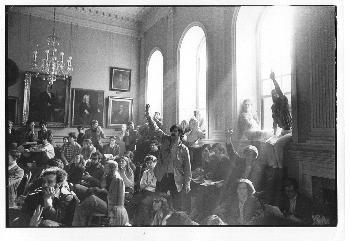
On April 9, dozens of Harvard students occupied University Hall to demand the abolishment of the ROTC program. Such protests were to become routine on college campuses throughout the war.
What next?
On July 8, Nixon withdrew 35,000 American troops from Vietnam, and the Manson Family murdered Sharon Tate and friends in Los Angeles.
Twelve days later the Eagle landed on the moon.
Late in August, a half million hippies congregated in the Catskills for an aptly-named “Aquarian Exposition: 3 Days of Peace & Music,” also known as Woodstock. Good guys. And on November 15, a nationwide moratorium on the war saw millions of Americans young and old—students, working men and women, school children—boycott jobs and classes to participate in anti-war activities. The tide was turning.
But on December 6, the Altamont Speedway Free Festival in California, promoted as “Woodstock West,” turned into a bloody brawl.
The year ended with the withdrawal of another 50,000 troops.
Vietnamization
The next three years of the war played out in Living Color on TV, with all its atrocious horrors, all around the nation and the world. The world was horrified. What had begun among the young became a groundswell of protests and demonstrations, marches, clashes with police and soldiers—also on TV. Politicians, pressured by constituents, pressured Nixon to fulfill his promise and wind it up. He saved face with “Vietnamization,” a clever policy he hoped would appease them. In essence, it reduced the number of GIs based in country, leaving the ground war to the natives, while continuing to show strength with from the skies.
In 1970, he withdrew 150,000 troops; 65,000 more in ’71; by November, ’72, only 16,000 Army advisors remain in country. He then ordered twelve straight days (December 18-29) of the most intensive bombing of the war, with waves of B-52s dropping more than 100,000 bombs on Hanoi and Haiphong.
And on January 29, 1973, he abolished the draft—to the huge relief of American boys and the people who loved them.
By that time nearly three million Americans had fought in the never-declared war and suffered roughly two hundred thousand casualties: one in fewer than fifty dead, one in eighteen wounded. Compared to the four million Asian (Vietnamese, Laotian, Cambodian) soldiers and civilians dead or wounded (and millions more displaced), Americans came out far ahead—twenty to one.
But Vietnam won the war.
The ’72 Election
1972 was a banner year for Nixon on the world scene, from his January announcement of the Space Shuttle program to cooling down the Cold War, first with his unprecedented eight-day visit with Chairman Mao in February, then, in May, with Soviet leader Brezhnev, where they signed the groundbreaking Salt Treaty.
The home front was another story.
With all the boys back from the war, the focus of the Movement shifted from life or death to moral (and economic) condemnation of a nation that continued to waste billions dropping bombs on innocent people (who were, after all, just fighting for their freedom), but to ignore the gross inequities that carved its citizens up into groups according to a multitude of discriminatory factions that too often fought among themselves.
Construction Zone
From this point on is a jumble
One thing they held in common was dislike of “Tricky Dick” Nixon, and all campaigned passionately against his ’72 reelection. His landslide 49-1 victory demoralized the young and marked the beginning of the end of the Revolution.
To solidify the coalition, the Family of Living Light held its first World Rainbow Gathering (a Woodstock redo) in Granby, Colorado, near the sacred Table Rock. The Family, a back-to-nature hippie tribe, welcomed all who shared a fundamental ideology of peace and harmony, truth and justice, freedom, and respect, to four days of sex, drugs, rock & roll, and political revolution on the Fourth of July.
music and peace and enjoy the July Fourth Weekendwelcomed the gatherings free and open, “bring if you can, as much as you can—but nothing to sell,” who share Their goal was to create a utopian culture, free from consumerism, capitalism, technology, and all the other established isms— one that would be serve as a model for mainstream reforms.was conceived by activists Barry Plunger and Garrick Beck Barry Plunker
naked march on July 4
non-hierarchical, that would further world peace, and serve as a model for reforms to mainstream society. However, the values actually exhibited by the group have at times varied quite a bit from this
But a year later, Watergate exposed the criminal corruption of the President and his administrative cronies, and public pressure forced him out of office.
To not only for peace, but for all the other causes that divide humans into . The unity that r bo, on the other hand was a mixed bag. Among a number of firsts: the hand-held calculator, Things on the homes front weren’tUNESCO’s Year of the Book was a banner year for Nixon. He signed the SALT Treaty with the Soviets, reestablished US relations with China, while the Dow Jones average topped 1000 for the first time ever. .in fact “one for the books
On June 17, five men were caught in the act ransacking the offices of the Democratic National Convention Headquarters at the Watergate Hotel in Washington.
Six weeks later, on July 1, Hair rang down the final curtain, after 1,750 performances. Earth Day, April 22, 1970, Ken State, May 4, Beatles Let It Be (last album)
And he ended the draft
1972
. From the SALT treaty Among the many milestones was the first hand-held digital calculator (HP-35) is introduced (price $395)one saw the introduction of the hand-held calculatorfirst e, as optimism soared and and in ’73, he abolished the military draftBy then
He also ended the
As the boys came home, the counterculture
othermusic
1970 Beatles split; Elvis 1st ex-soldier concert
June 17, 1972, Watergate break-in; Hair closed Jul 1, 1972
Watergate
On June 17, 1972, five burglars were caught ransacking the offices of the Democratic National Convention Headquarters at the Watergate Hotel in Washington, and the nation turned its attention form the war to the scandal in the White House—once again on the same opposing sides, preponderately (at first) the Establishment and others who refused to believe the President was a crook. He won re-election 49-1.
On the other side stood the Democrats, the liberal intelligentsia, and the hippies, whose many divers causes, no longer focused on the War, found common cause in Nixon. If they could force him out of office, it would be “like, man, like, a coup, like—wow!” All their problems would be solved.
As time went by, evidence uncovered by Washington Post journalists Bob Woodward and Carl Bernstein demanded official investigation, and on May 17, 1973— eleven months after the break-in—American’s tuned in live to witness the first in a year’s worth of hearings conducted by the U. S. Senate Watergate Committee, the truly honorable North Carolina “Senator Sam” Irvin presiding. Evidence and testimony ultimately determined Nixon was a crook, and on August 8, on live TV, he became the first American President to resign.
If only there had been a leader. Every revolution needs a leader, some one person recognize by all to be the one to know they way, the hero, the statesman, the radical—the one to follow. George Washington. Simon Bolivar. Joan of Arc. Lenin. Sun. Mao. Castro. Ho Chi Minh. (No Hitler, please. Nor Mussolini, Stalin, Attilla the Hun, nor Trump.)
The problem was their greatest strength: diversity. No one among them was like all of them. Each cause was organized within itself, with national leadership and chapters everywhere, but never was a coalition formed to recognize their only universal commonality. We’re all human beings.
There were attempts. In 1972, hippie activists Barry Plunger and Garrick Beck (son of Julian) formed the Family of Living Light and held its first World Rainbow Gathering—a 4-day Woodstock redo—to celebrate the 4th of July in Granby, Colorado, near the sacred Table Rock. The Family, a back-to-nature hippie tribe, invited any and all from anywhere who shared a fundamental ideology of peace and harmony, truth and justice, freedom, and respect, to Strawberry Lake for three days of sex, drugs, rock & roll, and political soap box revolution on the Fourth of July. “Bring if you can, as much as you can, but nothing to sell,” was their slogan, and the invitation was open free of charge (no money was permitted) to share experiences, love, dance, music, food, and learning, and to pray for world peace.
This organization still exists, hosting one official World Gathering a year and harboring a number of independent affairs all around the globe. They last from four days to six weeks (in Israel, in 1992), and draw as many as 20,000 back-to-nature peaceniks.
They don’t get a lot of press.
More familiar is Fred Hampton’s 1969 Rainbow Coalition of black, brown, red, and yellow, later under the umbrella of Jesse Jackson’s more tolerant Rainbow/PUSH. Today humanity is covered in the U.S. by the American Humanist Association, a non-profit organization promoting atheism, and the National Endowment for the Humanities, with an annual allotment of $162.25 million—0.00004% of the 4 trillion dollar national budget.
Aftermath
Meanwhile, the Revolution underwent a transformation, as hippie styles and customs attracted wannabees and profiteers, hangers-on who grew the numbers but sidestepped true commitment diluted the became the vogue and infiltration of wannabees and profiteers
absorbed in the culture,
backlash, political correctness
y
My Lai
If there was to be Revolution
, The high point came in ’69, at an aptly named
By then the tide was turning against the Hawks,
litany of irrational tradition, superstition, and taboo, judicial inequity, discriminationrace/gender bias, WASP-male dominated institutions— economic and ethnic inequities, institutions.
For this Moment, the world belonged to young idealists who believed in peace, love, freedom, joy, and music, whose war with the Establishment, like the Viet Cong against the US, . song hair was chic among the hip, and the world began turning against the war.
Sadly, the Establishment struck back from all directions, and with the end of the war in ’75 all factions went their ways, but the Hair became a milestone in post-modern he influence of ir music opened doors , with gaudy imitations , and the Revolution faded into Watergate and economic practicality; hippies , but music commercial Realism
its impact on to the tragic endingarray of joys and agonies to agony and . , from its for generation First, it defined and epitomized Revolution, its the Revolution of and for the hippie generation, from
Rather, as time went by, the innovations were absorbed into the mainstream. Albee’s classically absurdist play, “The American Dream,” for example, was transformed into the equally, but more subtly absurd psychological Realism of Who’s Afraid of Virginia Woolf.
a manifesto for the anthem for the revolution: “The Age of Aquarius.”
range of music matched to words
that interacts with others in a virtual piñata of capture on stage the moment when the youth of America to weave a living portrait of the emerges with others overall into a curtain call, the audience on stage, all singing “Let the Sunshine in.”
In the end, these writers matured into the mainstream,,
these dissidents were ridiculed, abused, and scorned, to sentiments were first and foremost prevalent on college campuses, “dropped out, turnedfled the country. , suddenly struck by the the left-leaning young, who challenged the Establishment. They had marched for civil rights and women’s lib, but the war in Viet Nam was absurd, and they protested vehemently. As opposition to the war arose, —in particular, on college campuses, where young radicals replicated and personalized wrote absurdist , at professional (foundation-funded) regional theatres and at colleges and community theaters nationwide. The new plays Writers who expressed embraced free choice in the realization of absurd reality touched a nerve among the disaffected Their works range all over a spectrum of issues, forms and styles from farce to travesty, barebones to spectacular,
playwrights everywhere were writing plotless, pointless, often very funny plays about very serious issues
For the rest, The economy boomed, technology advanced, and people knew their place. most Americans FiFor most white Americans, the ‘Fifties were Leave it to Beaver, cottages and picket fences. good times, when everybody knew their place. College students picked fields to prepare for the work they planned to do—mostly business, education, science, medicine, or law. Arts were low on the list, with likely drama last: Who makes a living doing theatre?
An Aftermath to Every War
Civil War/Reconstruction & the Westward Movement; WWI/The Roaring Twenties & the Great Depression; WWII/Rock & Roll; Vietnam/Commercialism
The number of accidental incidents that launched wars; the number of stupid mistakes
The first of far too many horrible and grave mistakes over the next two decades when President Harry Truman refused to respond to letters from this democratic president.
The war convinced the world that America was not invincible
Too Much Information
Lack of faith in religion and civil institutions
Hope in spite of the Absurd
Artists and the intelligentsia stand for liberal, humanistic causes
Complete secularization (and commercialization) of dramatic art.
Zombies
in reference to Vietnam Remember The Living Theatre? Their last production before Judith Malina and Julian Beck? and The fight against the war began among pacifist, post-war, beatniks in New York and San Francisco long before the current crisis, but the movement gained momentum on college campuses, where susceptible draftees burned their cards and occupied buildings in protest, chanting, “Hell, No! We won’t go!” People disregarded abandoned cultural distictions prejudices of race, sex, beauty, classage, Against the establishment majority, ruled by rich old white men, they brought diverse minorities together in one common cause to picket, march, communicate, and demonstrateand picketed recruitment offices. came togetherheterosexual meFor a while the whole nation focused on one cause, from two directions. —from opposite positions. classmates were called to active duty This energy flowed over into theatre, once again, to redefine dramatic dramatic art—not as a movement, but an infinite hodge-podge of revolutionary ideas and practices that defy collective definition.
they made their voices heard, not only against the war, but the social system that not only sent its sons to kill and die but also denigrated women, persecuted people of color, tormented gays, preached Christianity, and kept all the money for itself. The military-industrialist complex. The Establishment.
Republicans, once northern liberals (left) until FDR, Democrats. southern conservatives (right) until Brown, when they became first Dixiecrats, then conservative Republicans (Jesse helms), as northerners became liberal Democrats.
The opposition were younger generation men of draft age and the “peaceniks” who loved them. —Existentialists, who saw no point to the war and rejected the society that waged it. With long hair and braless breasts, these “hippies” rallied for peace and love and joy—sex, drugs, rock & roll. Their colorful, musical, non-violent protests ignited a revolution that rocked the world, and for the next ten years flower children tilted at the windmills of the Establishment. What could be more absurd?
 Cold Reads/International