
Modern Times
Too many factors are involved in the transformation that occurred in the western world over the next 200 years to cover in the context of this essay. From the enlightened writings of rational philosophers (and a crumbling aristocracy) came wars, not for land or religious faith, but for bread and freedom; then Napoleon, more revolutions, the rise of the British (and fall of the Spanish, French, Dutch, and Holy Roman) Empires, the Industrial Revolution, Freud, Darwin, and Marx, and the Great Depression, sandwiched between two world wars, at which point the Modern Era ends and Postmodern life on earth begins, with America (vs the Bad Guys) in control.
Rule, Britannia
England, like the rest of Europe, was continually engaged in war throughout the 18th Century, with France her major rival; but while the continental nations fought to expand or protect their homeland borders, England took command of the seas, built a world-wide trading network for its merchants, manufacturers, shippers and financiers, and emerged at the top of the heap, where it remained for all but the end of Modern time.
The Last of the Stuarts
Charles II died in 1685 and left left the throne to his equally libertine brother, James II, a devout Catholic, who was quickly deposed (1688), and his daughter, Mary II (and her Dutch cousin/husband, William of Orange), had come to rule English world.
Meanwhile, radical change was taking place in society, as a new “middle” class of merchant citizens arose—predominantly protestant parliamentarians—who protested the King’s divine right and ungodly lifestyle and denounced the theatre on moral grounds, forcing playwrights to soften their tones. Tragedies found happy endings; comedies taught moral lessons; carnal topics were taboo; and all plays aimed to “please and (morally) profit.”
Notwithstanding these concessions, anti-theatre sentiments persisted, culminating in the publication of A Short View of the Immorality and Profaneness of the English Stage (1698), an essay by theologian Jeremy Collier accusing all playwrights (and actors) of profanity, blasphemy, indecency, and undermining public morality through the sympathetic depiction of vice.
The last great playwright of the Restoration—and of the English Renaissance—was William Congreve, whose Love for Love (1695) prompted Collier’s diatribe, and whose masterpiece, The Way of the World (1700), defied it. Both plays rejected the softer style in favor of Wycherley’s hard cynicism, using quick wit, clever irony, and sex to depict a society of sly intriguers, fops, and fools. Amoral and irreverent, these plays exposed hypocrisy and greed among the gentry, and audiences hissed and booed. That said, the latter of the two remains among the greatest of all English comedies.
The Glorious Revolution
The political war between both Charles and James and their several Parliaments officially ended in 1689, when Protestants William and Mary, having accepted the terms of the English Bill of Rights, became the world’s first constitutional monarchs since the Hittites. From that time since, although the crown remained a right of royal (and non-Catholic) blood, it was not divine or absolute; the British government is run by Parliament.
Mary II (co-reigned 1689-94) was the legitimate heir to the throne, who married her cousin William, Prince of Orange, at age fifteen, while he, at twenty-seven (and fourth in line himself), was fighting both the Franco-Dutch and the Anglo-Dutch Wars. The marriage settled the latter, but conflict with Louis XIV continued through the years, at issue the royal lineage: Louis favored the Catholic James II. To preserve the Anglican state religion, the English Parliament deposed King James II and offered the couple the crown, setting off a series of Jacobite rebellions that continued will into the reign of George II.
Mary dutifully submitted to her husband’s rule as he put down rebellious Catholics and resistors and joined the Grand Alliance in the Nine Years War, until she died of smallpox, childless, at thirty-two, leaving him to rule alone.
William (reigned 1689-1702) was a warrior prince, leading his armies abroad from spring to fall, fending off Jacobite plots at home, embroiled in politics and finance fall to spring. He granted land in America (the Carolinas) and, in 1694, chartered the Bank of England, modeled on the Bank of Amsterdam, which laid the financial foundation of the English take-over of the central role of the latter in the global commerce of the upcoming century. And in the year of his death, he intervened in the War of the Spanish Succession (1702-14)—the first of more than a hundred wars and rebellions that involve Great Britain before the century’s end—to kick it off.
More to the point, William was a Calvinist, which, on one hand, assured that the crown remained Protestant, but which—although he converted to the Church of England—troubled the Anglican Tories, especially since he didn’t remarry. (It was rumored he was gay.) More to our particular point, his Puritan bias and bellicose sensibilities included no aesthetic complement, and he refused to subsidize the arts. This forced theater to compete on its own in in a suddenly surging commercial economy, with plays that appealed to the common man of the time, but had no lasting impact.
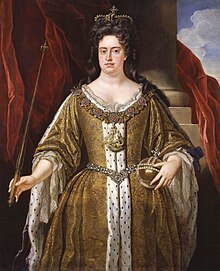
William’s death led to the crowning of Mary’s sister as Queen Anne —the last of the Stuart monarchs—whose reign (1702-1714) coincided with the North American theater of the War of the Spanish Succession, known in Great Britain as Queen Anne’s War, and in the United States and the French and Indian War. The European battles were waged to decide whether Spain would be ruled by France or the Holy Roman Empire, and since either option would severely upset the balance of power, other nations joined in, taking sides, England against the French, but arguing for an independent Spain. In the end, the Bourbon grandson of Louis XIV wore the crown, but Spain remained separate from France.
The American war was utterly Anglo-French, with Native American tribes aligned on either side, and resulted in England acquiring Newfoundland and Acadia from France, Gibraltar from Spain, and a 30-year monopoly on the transatlantic slave trade, which brought great riches to the English treasury.
Aside from war, Anne’s reign is noted for significant events that shapes the course of history. The Acts of Settlement (1701) assured the throne would be forever Anglican; the Parliamentary Acts of Union (1709) combined England and Scotland to create the Kingdom of Great Britain, and the 2-party system of government emerged, with the aristocratic Anglican Tories against the common Dissident Whigs.
History has not been kind to Anne, owing mainly to an unflattering portrayal of her in the memoirs of a former confidante and perpetuated in the award-winning 21st Century play and film. While it’s true that in her later life she was obese and ugly, crippled with gout and diabetes, and frequently out of sorts, but she was neither stupid nor unwise.
She conducted affairs of state through her ministers, but her upbringing and inclinations were more liberal than those of her predecessors, and fine art flourished during her reign. In her youth, she studied music (harpsichord and guitar), dance, and acting, and frequently performed; as queen, her court became a cultural center, attracting many of England’s greatest painters, poets, authors, and composers; Queen Anne’s architecture and furniture are name for her. Henry Purcell composed the music for her wedding.
All said and done, Queen Anne presided over an age of artistic, literary, scientific, economic and political advancement that was made possible by the stability and prosperity of her reign.

Even theatre packed the houses, although the plays were mediocre. Besieged siege by the puritanic hoi-polloi to clean up its moral act (on stage and off), deprived and censored by King William’s Calvinism, producers had been forced to “soften” their classic repertoires. Under Anne new plays appeared with middle class protagonists and sentimental, black-and-white themes intended to illustrate the essential moral goodness of humankind. They drew large crowds but left no legacy. History remembers only the works of Colley Cibber (The Careless Husband, 1704) and Robert Farquhar (The Beaux’ Strategem, 1709), who authored bourgeois tragi-comedies that, in tandem with similar forms in France, would dominate most of the 18th Century and evolve into the melodrama and burlesque of the next, that emerged as the soap opera and sitcom we know today. The English Renaissance was done.
Enlightenment
The French define the Age of Reason as the time between the death of Louis XIV (1715) and the outbreak of the French Revolution, with roots in Descartes’s startling revelation, “I think; therefore I am” (1637). In England, it begins with the publication of Isaac Newton’s Principia Mathematica in 1687, its roots in Shakespeare and Ben Johnson, and ends with American War for Independence. For dramatic purposes, it’s the Eighteenth Century.
This time is marked by astounding advances world-wide in intellectual and humanistic ideas centered on the sovereignty of reason and the scientific evidence of the senses as the primary sources of knowledge and advanced ideals such as liberty, progress, tolerance, brotherhood, constitutional government and separation of church and state.
It was also a time of a widening gulf between the prosperous and the poor. The vast majority of people (80% or more) lived in poverty and squalor. Royals, clergy, nobles, and the upper-upper middle class enjoyed luxurious lives in luxury, with time and means for education, arts and science, leisure entertainments.
This gulf was nothing new. A century before, there had been no middle class at all—the eighty percent were all slavish serfs. By the end of this one, the shoe was on the other foot, and for the rest of Modern history, the world progressed toward freedom, brotherhood, and equality.
Until post-Modern time, and the Age of Trump. But that’s a later story.
In England, the cultured classes produced and absorbed the enlightened philosophies of Benthan, Berkley, Priestly, Hume, and Adam Smith; the poetry of Coleridge, Worsdworth, Shelley, Keats, and Blake; the novels of Fielding, Defoe, Austin, Holcroft, and Swift; the paintings of Turner, Constable, Hogarth, Reynolds, and Gainsborough; the music of Handel and Purcell; the scientific works of Priestly, Cavendish, and Faraday—among numerous somewhat lesser others. In America, English colonists read Jefferson and Franklin, Hamilton and Adams, Thomas Paine.
The Kings George
Although Queen Anne bore seventeen likely heirs in her forty-nine years, not one survived past infancy, and her since her closest protestant relative was a German second cousin, Georg Ludwig—great-grandson of James I—the English crown fell to the his House of Hanover, where it remains today (renamed Windsor in 1917, for xenophobic reasons).
For more than a century (1714-1837), the both Great Britain and the Electorate of Hanover were ruled by Hanoverian patriarchs who, early on, were more at home in their native land. There, their rule was absolute; in Britain their powers were vastly limited by Parliament.
George I (reigned 1714-27) spoke fluent German and French, good Latin, and some Italian and Dutch, but very little English, and he’d rather have been at home; his government was run by his French-speaking ministers—most prominently Robert Walpole, the nation’s first Prime Minister—and a Parliament of Whigs, who stripped more powers from the throne.
Nonetheless, in spite of early trade wars and Jacobite rebellions, a later economic crisis, the political adversity of his son and heir, a court that ridiculed his flaws, and a population that considered him “too German,” his reign was benevolent; he valued humanist ideals, and encouraged progressive thought.
Not so his successor, George II (reigned 1727-60), for whom the American State of Georgia is named. Depicted historically as a boorish buffoon, he was at his best in battle, first in 1708, at twenty-five, as heir apparent to the Brunswick-Lüneburg Electorate, “distinguishing himself extremely” in the War of Spanish Succession (1701-14); later as King of both England and Hanover, leading his troops against the French in the War of the Austrian Succession (1740-48)—the last English monarch to do take up arms.
His reign also included the last three Jacobite rebellions, The War of the Quadruple Alliance (1717-20), Drummers War (1721-25), the Anglo-Spanish War (1727-29), The War of Jenkins Ear (1740-48), and the French and Indian) War (1754-56), which extended through the Seven Years War (1756-63).
Otherwise, this second George, ill-tempered and besotted, hunted stag on horseback, played cards, and enjoyed the company of his several mistresses, while Walpole ruled the kingdom. He donated the royal library to the British Museum in 1757; he had no interest in reading—nor in the arts and sciences.
Dramatically, for the most part, theatre was simply entertainment.. The Beggar’s Opera (1728), a ballad opera by John Gay, was the most popular play of the century and is frequently performed today, while George Lillo’s The London Merchant (1731) found tragedy in the common man; both pleased the crowds and profited the houses.
Politically, Henry Fielding wrote burlesques (a form of comedy) that savagely satirized society and Walpole’s government (The Tragedy of Tragedies; or, The Life and Death of Tom Thumb the Great, 1731) that so inflamed (and frightened) the Minister that he decreed the Licensing Act of 1737, requiring every new play in England to be read and approved by the Lord Chamberlain before performing it in public—a form of moral censorship that hobbled and autocratically directed dramatic art in Britain for the next two hundred years, until it was repealed in 1968.
Walpole fell from grace and was forced from office in 1742, but during his 20-year tenure, he expanded British interests throughout the world (the first British Empire), extinguished the Jacobite challenge to the Hanoverian dynasty, and established the power of ministers and Parliament in Britain for all time.
The heir apparent to George II was Frederick, Prince of Wales—his polar opposite opposite in every way (a Whig). Charming, temperate, tolerant, peace-loving, intellectually enlightened, and enthusiastic patron of the arts and sciences—had he outlived his father, the world might be a better place today. Alas, he didn’t, and the crown fell to his eldest son, whose ensuing 60-year reign (1760-1820) stands as the longest of any male English ruler ever; only Queens Victoria and Elizabeth II, exceed him, and he barely exceeds Elizabeth I.
King George III, by the age of eight, could read and write in both English and German, and comment on political events of the time. He was the first British monarch to study science systematically. Apart from chemistry and physics, his lessons included astronomy, mathematics, French, Latin, history, music, and geography.
He came to the throne in the middle of the Seven Years’s War, which won New France and Spanish Florida, and instituted fiscal reforms that made him popular throughout most of his reign, despite the loss of his American colonies in 1783. He was atypically a frugal and highly moral king, unlike his father; he never had a mistress. His time is marked by the addition of Ireland to Great Britain, the birth of the Industrial Revolution, the Napoleonic Wars, the War of 1812, the transportation of 1.6 million slaves out of Africa to British colonial possessions, and at least four prolonged periods of psychotic behavior, which earned him the nickname Mad King George.
Theatrically, with only two delightful exceptions, the repertoire remained the maudlin same. Oliver Goldsnith (She Stoops to Conquer, 1773) and Richard Brinsley Sheridan (The School for Scandal, 1777) revived Restoration comedies of manners with a moral twist, and stand up well today. Sadly, they had no followers, and life dramatic art was mediocre for the next 100 years.
Playhouses
From the Restoration of Charles II in 1660 through the early reign of George II, the patents granted to Davenant and Killigrew remained in force, sometimes as one company, then as two, playing at Lisle’s Tennis Court (until 1705) and Drury Lane; then at Dorset Garden (1671-1709), The Haymarket (from 1720) and Covent Garden (1732). From 1737, only Drury Lane and Covent Garden were licensed to play drama—until 1766, when The Haymarket was permitted to play in the off season (Mid-May to Mid-September).
[Note that although both Drury Lane and Covent Garden were twice destroyed by fire and rebuilt, greatly enlarged, and upfitted, and The Haymarket has undergone two major reconstructions, these three monuments remain on their original sites, the heart and soul of London’s West End.]
Anyone with sixpence could attend, from royals to the hoi-polloi, and many did, although the bill of fare was rarely the main attraction. Those who weren’t distracted—flirting, buying and selling, being seen—were cheering, clapping, booing and hissing, interjecting, sometimes taking sides—or protesting, with placards and noise-makers, some with rotten fruit and vegetables; suddenly there’s a duel—or a brawl.
Theaters at that time were the preferred venues for popular indoor disturbances. History notes the Old Price Riots of 1709, on opening night of Macbeth in the brand new second Covent Garden to protest a penny rise on a the price of a sixpence seat, that lasted for sixty-four days. Although they didn’t happen often—one or two a year between in London between 1730 and 1780—there was always the risk, for reasons ranging from price of a seat to a quarrel between actors and their flocks of devotees, to the moral, social, political, or religious content of the play, or the quality of its production. Rarely were they violent, nor did they significantly affect the status quo, but they suggest to the enlightened mind the social sensibilities of the audience. Gentle Riots? is a lengthy but but engrossing thesis on the theater as the place for social protest.
No wonder actors of the time declaimed—they had to, to be heard.
Maybe it’s for all these reasons (and the law that said the company owned the playwright’s work) that so few great plays came from all those many years.
By 1800 all three patent theaters had been enlarged to seat as many as 3,000 patrons, but London was now the world’s largest city, with over a million inhabitants, many of whom were ripe for entertainment. The government relaxed its rules, and over the next four decades, eighteen more were constructed, all playing melodramas, bowdlerized Shakespeare, and, late in the century, the operettas of Gilbert & Sullivan.
Theatre in the Colonies
In the early 16th Century, Spain and Portugal brought church plays to Latin and South America and used them to convert the heathens. The first North American play was written in New France in 1606, before it became part of New England, where plays were forbidden. The first recorded performance of play in what would become the United States, however, was in 1665, when three men in Virginia were hauled into court for performing a (lost) playlet, “Ye Bare and Ye Cubbe,” and with rare exceptions, another seventy-five years passed by before the next.
Early in the 18th Century, unrecorded but quite likely, were a few small groups of amateurs who put on plays, first in the south, in Williamsburg (where the first colonial theatre was built in 1716) and Charleston, then Philadelphia and New York (the first American play, published in 1714). Alas, John Wesley and George Whitefield arrived on the scene in the 1730’s, preaching revivals in the First Great Awakening, followed by the Revolution, and the dramatic spark sputtered.
In 1749, one such group formed the Murray-Keane Company in Philadelphia and played until the audience played out, then moved on to New York, then to various towns in Virginia and Maryland, before it vanished from history in 1752—the very year Lewis Hallam arrived in Williamsburg from England with his small troupe of third-rate professionals.
Like Murray-Keane, the Hallam Company played to (and played out) audiences in Charleston, Philadelphia, New York, until they were themselves played out, and in 1755 they sailed off to Jamaica (where plays had been performed since the early 1680’s) to join the company of first-rate actor-manager David Douglas. When Hallam died, Douglas married his widow, the two groups merged into The American Company and, in 1758, returned to the mainland, where they played until the Revolution. They staged the first professionally-produced American play (Thomas Godfrey’s The Prince of Parthia, 1767) and built not only the Southwark Theatre in Philadelphia—the first substantial permanent playhouse in America—in 1766, but also the John Street Theatre in New York (1767) and others down the coast to Charleston.
Note that this is the only professional company ever to play the Colonies. Performances were forbidden by law in many states in the wake of the Great Awakening, and while a few colonial amateur dramatists provided a variety of patriotic plays excoriating British rule, they are remembered only for their fervor—and their coinciding with the German Sturm und Drang.
The Continental Congress banned all performances in 1774, and the company retired to Jamaica for the duration of the war, to return a decade later as the The Old America Company in the John Street Theater, where they played for twenty years.
Aside from being the first of their kind, these companies were simply dull flashes in the pan. The first truly professional theatre in the New World would play in the US of A.
The German Enlightenment
Throughout the 18th Century and well into the next, despite its slow collapse, France remained the most powerful nation in continental Europe, and all the others aspired to follow her example, in fashion, architecture, art, government, you name it—for over a hundred years. French was the language of the culturally elite. Consequently, after the French revolted (and after Napoleon), the mimicker princes all fought their own bloody Revolutions of 1848, after which Otto von Bismarck, Prime Minister of Prussia, united all the principalities and claimed the top of the hill for the new German Empire (1891).
The stage was set, however, by Frederick the Great (1740-86), whose enlightened diplomacy consolidated the various states of Prussia and whose patronage of the arts paved the way for the next major movement in dramatic literature.
Sturm und Drang
It begins in Hamburg with a brief burst of plays by a group of young literary revolutionaries, the sole intent (and only similarity) of which was the flat rejection of the Academie franciase and all it stood for. Generally described as Sturm und Drang (storm and stress)—the title of one of the early (1776) plays—they splintered off in all directions, both in style and structure, although all spoke to the tumultuous times. Very few were produced—fewer still successfully—and with no common elements, they never coalesced into a movement; but all were widely read and discussed for their radical points of view, and two of its authors, Johann Wolfgang von Goethe (Goetz von Berlichingen, 1773) and Friedrich Schiller (The Robbers, 1782) later achieved universal greatness.
It’s more than mere coincidence that these plays were written during the American Revolution; several, including Sturm un Drang (1776) are set in the colonies, and argue for independence. Their attitudes began to seethe among the lower classes.
Lessing, Goethe, and Schiller
Before the 18th Century, there was no German drama. English companies had toured the continent playing Shakespeare as early as the 1580’s (until the Thirty Years War), after which princes and aristocrats engaged French troupes to play Moliere. What passed for public theatre was a hodge-podge of serio-comic sketches featuring Hanswurst, the clown.
The first indigenous German dramatist was Johann Christoph Gottschedd, who joined the company of Caroline Neuber in 1727 to banish Hanswurst and create a public audience for his pedantic German versions (and imitations) of the Frenchies, in Leipzig and on tour. Sad to say, the public wasn’t ready. Hanswurst reappeared, the plays revised to make ends meet, and the new drama floundered and fizzled.
The first significant German dramatist—and the world’s first dramaturg—was Gotthold Ephraim Lessing, whose play, Miss Sara Sampson (1755), was a sentimental bourgeois tragedy that made him famous. Over time, he realized that English drama was the more suitable model for German writers, and articulated his reasoning in Die Hamburgische Dramaturgie, a series of essays and critiques that coincide with his tenure at the short-lived Hamburg National Theatre (1767-69). Through them, he foretells the rational mix of Sturm und Drang and Shakespeare with Germanic national overtones that opened the door to Romanticism. He puts proof in the pudding with Minna von Barnhelm (1767)—Germany’s first national comedy—and his masterpiece, Nathan the Wise (1779), which pleads the case for religious tolerance, is considered the greatest philosophical drama of the century.
Johann Wolfgang Goethe (1749-1832) is the German Shakespeare. His novel, The Sorrows of Young Werther (1774), was the catalyst for the Sturm und Drang experiment, and the success of his play Goetz von Berlichingen made him, at twenty-four, the most famous young writer of his time. in 1776, he was summoned by the enlightened young Karl August, Duke of Saxe-Weimar, to join his privy council, where he served simultaneously as Commissioners of War, Mines, and Highways, and chancellor of the Exchequer. He was de facto the duchy’s Prime Minister, friend and confidant to the Duke, the public face of Weimar, and a major voice in its blossoming culture.
He also oversaw construction of the ducal theatre (1780) and led a group of amateur actors that provided the town’s only theatrical entertainment—until 1784, when a third-rate professional troupe leased the theater and remained in residence for seven years.
Meanwhile, three years in Italy (1786-88) persuaded him to abandon Sturm und Drang for a new approach to ancient Greek plays, based not on neoclassic rules and dictates, but on the underlying dramatic Gestalt, exemplified in his adaptation of Euripides’s Iphegenia in Tauris (1787). This first “Weimar” tragedy used Greek mythology to depict humanity’s ethical evolution from a narrow concern for self to an awareness of broader claims, and is often considered one of Goethe’s greatest achievements.
He returned to Weimar with a vision but no time, and his new play slipped into and among his many other obligations and interests. In 1791, Karl August appointed him to manage the Weimar Court Theatre, but he engaged a mediocre company, delegated an actor to direct, and enlisted under his Major General friend in the Prussian wars against the French Revolution, engaged in the Battles of Valmy (1793), Pirmasenz, and Kaiserslautern, and the Siege of Mainz (1794).
Then he hooked up with Schiller, and together they made history.
Friedrich Schiller is the Father of Romanticism. The son of a soldier, born in Wurttemburg during the Seven Years War, he was raised to become a priest but sent to military school, where he studied medicine—and wrote The Robbers. Posted at twenty-three as regimental doctor in Stuttgart, he left without leave to attend the premiere performance of his play, which which made him famous overnight, but for which he was imprisoned and forbidden to publish more plays. Defiantly, he deserted to Mannheim, assumed the role of resident dramatist of the state theatre, and wrote two highly successful but unmemorable Sturm und Drang-style moral tragedies. From there he found a wealthy patron in Leipzig and, like Goethe, turned to the past for inspiration—not to the Golden Age of Greece, but (following Lessing’s lead) to 16th-Century England. In 1787—the same year Goethe wrote his Iphegenia—Schiller produced Don Carlos (1787), a historical drama written in (Shakespearean) five-foot iambs with romantic overtones.
Curiously, both playwrights put their breakthrough plays aside for a decade to pursue other interests—Goethe writing poetry and prose, serving Karl August, fighting the war; Schiller studying the history of Europe, achieving fame with books on the Netherlands revolt and the Thirty Years’ War.
Although both won fame at early ages (Goethe at 24, Schiller 23) as leaders of Sturm und Drang, they weren’t contemporaries. The former was a decade older—his Goetz broke the ground in 1773 (when Schiller was fourteen)—and his fame and influence in Weimar were well established when the young doctor went AWOL to Mannheim for the opening of The Robbers in 1782. Each was aware of the other’s work, however. Goethe recognized the genius of the man whose work his had inspired, and was instrumental in Schiller’s appointment in 1789 as professor of history at the University of Jena, just twelve miles from Weimar. But five more years would pass before they met and bonded, became friends and allies in a project to establish new standards for literature and the arts in Germany.
The Weimar Court Theater
Volumes have been written on the synergy of these two literary lions—their vastly different temperaments, their violent arguments over conflicting theories; the rational Goethe, the emotional Schiller, both humanists with a common goal, each influencing the other, as the lower senses (feelings) colored Goethe’s classicism and Schiller gave romanticism humanistic cause, and together they established the Weimar Theatre as the leading playhouse in Germany. From the time they met (1794) until Schiller’s early death (1805), their company produced an impressive mix of plays from every place and time, from the Greeks and Romans to Shakespeare and Moliere, including a few of their own—Goethe in his Classical mode (Egmont, 1788), Schiller the Romantic (William Tell, 1804).
Strictly speaking, the two movements were poles apart. the one based on the rational thought, balance, order, and harmony of the ancients; the other on emotional feeling, imagination, nature, and raw instinct, with Gothic German themes. In practice, the line between the two was muddled, and in the long run, both movements merged into 19th Century melodrama; but Romanticism, with its nationalistic themes and overtones, had more impact on the course of history.
Schiller’s death resulted in Goethe’s loss of interest in theatre, although he continued to manage the Weimar Court until 1819. His last (and only other) play was Faust, his immortal masterpiece, Part I published in 1808; Part II in 1832—the year of his own demise.
German Romanticism spread spread over Europe—first to England, where the Romantic poets (Coleridge, Wordsworth, Shelley, Keats, and Byron) all wrote literary dramas (few of which were ever played)—then to France, where Hugo’s Hernani caused riots in 1830, after which—unlike Romantic music, art, poetry, and prose—Romantic drama as a movement fell apart. Throughout the rest of the 19th Century, playwrights either churned out melodramas for the masses or groped their way into the future, sowing the seeds of Modern Drama.
The Victorian Era
The 19th Century began with the Napoleonic Wars, moved through the Victorian Era (1837-1901) and the Industrial Revolution to La Belle Epoch in France and the Gilded Age in the U. S. Too much happened in the world to tackle here. (See Wikipedia: The 19th Century.) In a nutshell: The Industrial Revolution, with its factories and locomotives, electric lights and telegraphs, transformed life in the west from the horse-drawn to the horseless carriage and spawned dozens of the world’s great authors, artists, and composers. Germany united; The Holy Roman Empire became Italy and Austria; Spain and Portugal lost South America; Russia reared its ugly head, and America freed the slaves. By 1900, By 1900 every country in Europe except Russia had some form of constitutional government, and Great Britain, under Queen Victoria, controlled a fifth of the world’s territory a quarter of its population.
In general, the time is characterized by optimism, regional peace, economic prosperity, an apex of colonial empires, an exploding middle class population, and a deluge of technological, scientific, and cultural innovations.
Theatrically (ironically), while attendance was higher then than at any time before or since, the plays people saw were mostly maudlin melodramas, with elaborate special effects but flimsy plots and shallow characters—or bowdlerized versions of old favorites. The next major development would not begin until the end of the century, in Norway (of all places), with roots in Russia.
French Melodrama
The first use of the French word mélodrame was to signify a dramatic piece of music; ergo, the melo in melodrama actually implies drama with music—originally a spoken monologue; then a play with songs. The first use of the word in English was to describe Thomas Holcroft’s A Tale of Mystery (1802), based on a play by Pixérécourt, who wrote more than 200 best-forgotten mélodrames during in his 40-year career in Paris. But the form first found its shape in Prussia, with as many “sentimental” plays by August von Kotzebue, first produced (reluctantly) by Goethe at the Weimar Court, then all over Europe. By 1800, he was the most famous playwright in the world.
The most prolific of them all was Eugene Scribe, whose more than 300, while extremely popular, lack fine language, depth of character, thought, or social analysis, to the extent that Théophile Gautier questioned how it could be that “an author without poetry, lyricism, style, philosophy, truth or naturalism could be the most successful writer of his epoch, despite the opposition of literature and the critics?” His claim to fame was his formula for the “well-made” popular play that, adapted over time, remains the way plays work today.
In a nutshell: plays should be about the bourgeoisie, the characters involved in elaborate plots featuring clever twists and turns, usually centering on a misunderstanding revealed early on to the audience, but not realized by the protagonists until the final scenes. They face a series of physical and moral obstacles, the resolution of which may create in turn further problems. At the end, startling revelations lead to a sensational denouement. Sound familiar?
So successful were his plays that others copied his example, following his formula, churning out well-made melodramas all over Europe and America for the rest of the 19th Century. Feel-good tragedies with happy endings. That’s where the money was. (And they passed the censors.)
Suffice it to say, dramatic art had little lasting impact on the time. One significant exception is the stage adaptation of Uncle Tom’s Cabin which, according to Abraham Lincoln, “started” the American Civil War.
Bowdlerized Shakespeare
Along with melodrama, but less often, came the classics, sanitized to suit the censors, played by star actors in declamatory style. Victorian morality prompted adaptations of the classics that excluded inappropriate references. Thomas Bowdler’s The Family Shakespeare (1807) rewrote all 36 plays omitting sexuality, profanity, and political implication; Nahum Tate’s melodramatic King Lear featured a happy ending.
Modern Drama
From the end of the Franco-Prussian War (1871) until the beginning of World War I, most of the western world was stable, peaceful, prosperous, progressive, rational, trusting in the future. Known in France as La Belle Epoque (in England, Pax Britannica; in the US, The Gilded Age), arts and science flourished, technological inventions flooded the patent offices, all funded by growth capitalism. For the upper classes, life was a bowl of cherries.
The working classes, on the other hand, were exploited and abused, in growing poverty and squalor, as vividly described in the prose works of Charles Dickens and Victor Hugo. They, along with Darwin, Marx, and Freud (and from them Ibsen, Strindberg, and Chekhov), promoted rational thought, scientific truth, and social justice, and turned the world upside down.
Theatrically, the shift was seismic. All the old forms dramatic forms (and acting styles, scenic arts) were swept into a corner reserved for old chestnuts and replaced with revolutionary Realism and (its ugly twin) Naturalism—forms that essentially remain the mainstream mode today. Almost at once reaction triggered Symbolism, Expressionism, Surrealism, and a host of other innovative “isms” that have sprung up since and had their day, then merged with others over the years until it all became an eclectic blur.
Realism
Before this time, dramatic art had always been, by definition, artificial; a play is a work of art. Written as poetry since the Greeks and played in artificial settings according to artificial conventions (audience asides, presentational monologues, deus ex machina; sometimes wearing masks). The acting style was larger than life and loud enough to be heard over a restless crowd. One thing about a realistic play: one has to listen.
The realists abolished artifice in favor of real life on stage, down to the slighted detail, and for the first time, audiences witnessed actors playing ordinary people going about their everyday lives as though there was no audience, behind the “fourth wall” of the proscenium arch.
As with all the dramatic ages since the Greeks, Realism came about because of historical circumstances and events, reflected attitudes regarding them, and substantially affected the subsequent state of human affairs. Details of these parallels are the subject of a future essay. In a nutshell (in this case), Darwin, Marx, and Freud applied the recently formulated scientific method to their studies of the origins of species, the working class, and the human mind, and published their findings for an increasingly literate public to absorb. Their proofs and theories brought the world face to face with scientific reality, and changed they way people understood the world and humankind.
For now, just note that (1) all creative movements occur at the golden peaks of their cultural times; that (2) so far they seem to produce great playwrights in threes or fours; and that (3) in this case, a simple sound effect—”The Closing Door Heard Round the World” as the curtain fell on the opening night of Ibsen’s play, A Doll’s House (1879)—ignited international controversy on the issue of women’s rights.
The Early Russians
In 1702, Peter the Great imported a French company of actors and built a theater in his campaign to “westernize” Russia, and for the next 100 years, sporadically, neoclassic translations and (later) Russian adaptations were performed in court theaters by French-trained serfs. The first Romantic challengers were Alexander Pushkin (Boris Gudenov, 1825) and Nikolai Gogol (The Government Inspector, 1836). Then, for a cluster of subtle social reasons, Ivan Turgenev (A Month in the Country, 1850), Alexander Ostrovsky (The Storm, 1859), and Leo Tolstoy (The Power of Darkness, 1886) tempered the romantic, not with melodrama, but portrayals of real people, paving the way for Anton Chekhov and the scientific “method” acting of Konstantin Stanislavsky.
The Scandinavian Fathers
Serious drama first appeared in Scandinavia in the early Romantic plays of Norway’s Heinrich Ibsen (Peer Gynt, 1867) and Sweden’s August Strindberg (The Outlaw, 1871), both of whom in later years abandoned that form to write plays that would revolutionize dramatic art world-wide.
Ibsen is recognized as the Father of dramatic Realism. He authored a dozen realistic dramas, all addressing universal social issues of the time, from marital abuse (and syphilis) in Ghosts (1881) to corruption and greed (An Enemy of the People, 1882)—so shocking that the powers that were suppressed their production for two decades—but they were published, widely read and talked about, and spread all over Europe in several translations, inspiring a cluster of followers whose works challenged the status quo and defined Modern drama.
Strindberg became the Father of dramatic Naturalism, with The Father (1887) and Miss Julie (1888), among others. Of his more than sixty plays, only a few are naturalistic; others are historic, religious, chamber plays, and most famously, his “dream plays” (The Ghost Sonata, 1907), inspired by the works of Freud. Both dramatists were heavily influenced by Freud, as well as Marx and Darwin, but Ibsen is more socially inclined; Strindberg knows only the fit survive.
The line between Realism and Naturalism is fine and flimsy. Essentially, the former sees the world as it is; the latter digs into the (typically) sordid reasons why. It sees a play as a “slice of life,” taking place in real time, with no creative manipulation; while Realists cling to the artifice of the well-made play, if realistically portrayed. In practice, the Naturalist reveals a darker, more decadent world than the positive realist. The Father drives himself (or is driven by his wife) insane with doubt regarding their son’s paternity. Although others followed Strindberg’s example, with some controversial success, the trend was never popular, and it never became a viable movement.
Theatre Libre
Simultaneously, in Paris, on his own, Emile Zola developed his own nouvelle formule for drama, described in the preface to his dramatization of his novel, Therese Raquin (1873) and expanded in the essay, “Naturalism on the Stage” (1881). Neither his play nor those of his few disciples attracted notice, however, until André Antoine, endorsed by Zola, opened the Théâtre Libre (Free Theatre) in Paris (1887). Organized as a private club, it was exempt from censorship, and he began producing plays the boulevard venues couldn’t—e.g. Ibsen and Strindberg. It was he who emphasized strict attention to realistic detail in all aspects of production, standardized the convention of the “fourth wall,” and when Fernand Icre’s The Butchers (1888) called for sides of beef on stage, reality prevailed.
The Movement Spreads
Antoine’s example was quickly followed by the Freie Bühne in Berlin (1888), the Independent Theatre in London (1889), and others, featuring the works of Gerhart Hauptmann in Berlin (The Weavers,1892) and George Bernard Shaw (Mrs Warren’s Profession, 1893). Hauptman was a flash in the pan, but Shaw wrote more than sixty intellectual comedies on social issues, many of which remain in today’s repertory (and among the greatest ever written). Their impact on the course of modern history is significant.
Meanwhile, a decade later, Stanislavsky founded the Moscow Art Theater (1898) and applied the scientific method to the art of acting, presenting the works of Chekhov and Maxim Gorky (The Lower Depths, 1902)—and later still (1904), the Renaissance finally reaches Ireland as the Irish National Theatre Society at the Abbey Theatre in Dublin, producing the poetic-mythic symbolism of W. B. Yeats and the morally condemned realist works of J.M. Synge (Riders to the Sea, 1904).
Of these several luminaries, Chekhov stands out, along with Ibsen and Strindberg, as one of the three seminal figures in the birth of early modernism in the theatre. His four major plays—The Seagull,(1898), Uncle Vanya (1899), The Three Sisters (1901), and The Cherry Orchard (1904)—explored a withering aristocracy, his characters clinging to the past as he presaged the Russian Revolution. They also served as a platform for the Stanislavsky Method of acting still widely used today. Essentially, quite simply, the actor endeavors to “recreate and express—realistically—how people truly act and speak with each other to reflect the human condition as accurately as possible—a “mirror up to nature”—to inspire the audience to reflect upon their own definition of what it means to be human.
Anti-Realism
No sooner had Realism eclipsed all the old dramatic forms than a Pandora’s box of anti-realistic alternatives cropped up all over Europe, beginning with German Expressionism (B. F. Wedekind’s (Spring’s Awakening (1891) and French Symbolism (Maurice Maeterlinck’s Pelleas and Melisande, 1893); then Oscar Wilde’s Art for Art’s Sake (Salome, 1893), Alfred Jarry’s unique Ubu Roi (1897), W. B. Yeats’s reactionary poetic-mythicism (Cathleen ni Houlihan, 1902), French Surrealism (Guillaume Apollimaire’s The Breasts of Tiresias, 1903), and others between the two World Wars—Luigi Pirandello’s cryptic Iconoclasm (Right You Are, if You Think You Are, 1917), Italian Futurism and French Dadaism (1920’s; no significant literature), Federico Garcia Lorca’s poetic Fatalism (Blood Wedding, 1933), Jean Giraudoux’s anti-Nazi satire (The Trojan War Shall Not Take Place, 1935), Bertolt Brecht’s presentational Epic Theatre (Mother Courage and Her Children, 1938), Antonin Artaud’s Theatre of Cruelty (theory 1938; no plays), Jean Anouilh’s subtly resistance drama (Antigone (1943), and Jean-Paul Sartre’s Existentialism (No Exit,1944), which with Albert Camus’s essay on The Myth of Sisyphus, paved the way for the Theatre of the Absurd.
Add to these the evolution of musical theatre, from English ballad opera (John Gay’s The Beggar’s Opera) and French mélodrame to Broadway’s Oklahoma! (1943), from there to the magnificently extravagant spectacles of today, a few of which urge social action; otherwise, while they please—preferred by far by the public—they rarely profit anyone but the producers.
All of these diverse dramatic forms shared one thing in common—a rejection of dramatic realism. Not one found a popular audience, and soon faded into history, but all contributed elements to what ultimately became the complex, eclectic, and creative amalgamation that exists today.
Even Realism paled at first in comparison to the insignificant but extremely popular bourgeois melodramas, sentimental comedies and farces, and grand and ballad operas that pervaded English, French, and Italian theaters—their golden ages in the past. These forms all continued to be played as classics from the old days, but new plays adapted to the new reality. As the Twentieth Century turned, the era of bluster was over, and Realism reigned.
Along with Musical Comedy.
But that’s a later story.
The American Century
NOTE: The remainder of this narrative deals primarily with theatre in the United States, although significant happenings in other nations are addressed as they pertain to the human art.
Immediately after the American Revolution, theatre in the new United States began to thrive; within ten years four companies were touring the eastern seaboard. After the War of 1812, the exploding population migrated west, and by the end of the 19th Century, every major town and city from Boston to Sacramento had at least one “opera house” (more than a few on Broadway), with professional companies in residence or riding the rails on tour, playing on riverboats.
The early companies were simply imitators of the London stage, with English actors playing English plays. The first American playwright of historical note was Royal Tyler, whose comedy, The Contrast (1787), introduced the stereotypical Yankee character. Others followed over time, a few extremely popular, but very few enduring. Native actors rivaled British stars and toured The Drunkard (or Macbeth) to sellout crowds (or not) all over. Plays about the Common Man, the Noble Savage and Jim Crow were popular, but the only lasting theatrical innovation was the minstrel show.
Sadly, and ironically, the whole of 19th Century theatre is embodied in and triggered by the night of April 14, 1865, when an actor from a famous family of actors, John Wilkes Booth, went to the Ford, where President Lincoln was enjoying a performance of British playwright Tom Taylor’s Our American Cousin (1858), and committed the crime of the century.
Otherwise, although theatrical entertainment was abundant and very popular—and more and more spectacular, its stars celebrities—the plays were crafted to appeal to the masses, and are considered less than mediocre. At is peak, six names emerge as authors of successful melodramas: Augustin Daly (Under the Gaslight, 1867), Steele McKaye (Hazel Kirke, 1878), Bronson Howard (Shenandoah), William Gillette (Secret Service, 1895), James A. Herne (Margaret Fleming, 1890), and David Belasco (The Girl of the Golden West, 1905). Their well-made plays play well today, if played well, and many were made into movies.
In 1912, emulating the “free theatre” trend in Europe, a group in Boston f(of all places) ormed the Toy Theatre to stage amateur productions of new plays and launch America’s”Little Theatre” movement. Within five years there were 50 such “Little Theaters” in cities nationwide.
Eugene O’Neill
The first significant and arguably the greatest ever American dramatist, O’Neill’s first two Broadway plays—Beyond the Horizon (1920) and Anna Christie (1922)—won Pulitzer Prizes for Drama and opened the door for American realism, while he went on to explore and experiment with a wide variety of dramatic forms and genres—expressionism (The Emperor Jones, 1920; The Hairy Ape, 1922; All God’s Chillun Got Wings, 1924), naturalism (Desire Under the Elms, 1924; The Iceman Cometh, 1944), symbolism (The Fountain, 1922), surrealism (The Great God Brown, 1926), autobiographical family comedy and gritty drama (Ah, Wilderness, 1933; A Long Day’s Journey into Night, 1941), Noh drama and the Bible (Lazarus Laughed, 1926), Greek tragedy (Mourning Becomes Electra, a trilogy, 1931), and a 9-act Freudian marathon (Strange Interlude, 1928) in which characters in conversation express their unspoken thoughts as “interior monologues.”
Everything that’s happened in American dramatic art began with him.
His father was the actor James O’Neill, the model for James Tyrone in his autobiographical Long Day’s Journey, who “played Iago to Edwin Booth’s Othello” and vice versa. He bought the rights to Charles Fechter’s dramatization of The Count of Monte Cristo (1868) in the early 1880’s, claimed the title role, and famously toured the nation for thirty years—more than 6000 performances. His career coincided with and represents the apex and the end of melodrama’s century-long appeal. His son launched the American Century.
His early life, as told in Long Day’s Journey (and imagined, romanticized, in his only comedy, Ah, Wilderness!), was complicated by his Catholic family—alcoholic father and older brother and a morphine-addicted mother—and his own tuberculosis (and his guilt). Born is a trunk, as the saying goes, in the Barrett House Hotel on Times Square, he spent his preschool years “on trains and in hotels,” after which he went to Catholic schools. At nineteen, expelled from Princeton, he worked briefly as a secretary for a mail order house in New York, then sailed off to prospect for gold in Honduras. No gold, but he caught malaria.
During the next five years, he wandered home to manage a theatrical tour, act on the vaudeville stage, and report for the New London Times; then sailing back to work for Westinghouse, Swift Packing, and Singer Sewing Machines Companies in Buenos Aires, and wound up full time as an able-bodied seaman on the transatlantic American Line. He captured these years at sea in several of his early one-acts (“Bound East for Cardiff,” 1914).
In 1912, he spent six months in a sanitarium, related in The Straw, 1919, where he made the decision to become a playwright. He studied for a year with George Pierce Baker at Harvard, then joined the Provincetown Players (1916), where most of his early one-acts were produced. In 1918, Beyond the Horizon was produced on Broadway, and won his first of his four Pulitzer Prizes.
The rest is history.
The Best of the Rest
Scores of other playwrights followed his motley examples during both the Roaring Twenties, as people flocked to theaters all over the country. In the 1927-28 season alone, well over 250 plays appeared on more than 70 legitimate Broadway stages—the most ever, before or since—and although none equaled those of Gene O’Neill, many became modern American classics that influenced the Great Ones after WWII.
One early incubator of American dramatists was the Theatre Guild (1919-present), a major force in Broadway theatre well into the 1970’s and currently producing tours of Broadway musicals. Between the wars, it introduced Maxwell Anderson (What Price Glory?, 1924), Sidney Howard (They New What They Wanted, 1924), William Saroyan (The Time of your Life, 1939), and Phillip Barry (The Philadelphia Story, 1939), among others, and produced several by O’Neill.
Equally influential in the ’30’s was The Group Theatre (1931-41), founded by Harold Clurman, Cheryl, and (most famously) Lee Stasberg, featuring works by Paul Green (In Abraham’s Bosom (1926), Sidney Kingsley (Men in White, 1933), Irwin Shaw (Bury the Dead, 1936), and most famously, Clifford Odets, whose agit-prop drama, Waiting for Lefty (1933), based on a New York City taxi drivers’ strike, argued for a communist society, got 28 curtain calls on opening night, and ran for 144 performances.
Add to this list Thornton Wilder (Our Town, 1938), Elmer Rice (The Adding Machine (1923), George S. Kaufman and Moss Hart (You Can’t Take It With You, 1937), Robert E. Sherwood (Idiot’s Delight, 1936), Lillian Hellman (The Children’s Hour, 1934), and four female Pulitzer Prize winners: Zona Gale (Miss Lulu Bett,1921), Susan Glaspell (Allison’s House, 1931), Zoë Akins (The Old Maid, 1935), and Mary Coyle Chase (Harvey, 1945).
Early in the Great Depression, dissident elements of the Little Theatre movement coalesced into the New Theatre League, presenting plays written and performed by working class amateurs that expressed the hardships of peoples lives and leaned toward Marxian solutions. The leading company was the Theatre Union, which produced Tobacco Road (1933)—the only play worth noting—a naturalistic, muckraking mix of “impure, adulterous sex and blasphemous, profane, elemental comedy” set in poverty-stricken backwoods Georgia that so shocked and lewdly entertained the public that it ran for eight long years—3182 performances—second only to Life with Father (1939) as the longest-ever run of a straight (non-musical) Broadway play. By the time it closed, the Union had failed (1937) and the League dwindled into obscurity.
In 1935, the suddenly socialist FDR government created the Federal Theatre Project to pay 10,000 persons in 40 states—including African-Americans—to stage 1000 theatrical productions, 65% presented free of charge, but the project is best known for developing the “Living Newspaper,” in which the universal “little man” raises questions on a social issue, and the facts are acted out. So left-wing radical were these productions that conservative congressmen were alarmed, and two years later—four days before the opening of Marc Blitzstein’s The Cradle Will Rock two years later (directed by Orson Wells) about a union organizer, they withdrew funding and padlocked the theatre. Two years after that, the House Committee on Un-American Activities found cause to curtail the project altogether.
For all these noteworthy playwrights and their excellent body of work, the number of Broadway productions fell sharply during the Depression, from the high in 1927-28 (over 250) to 80 in 1940-41. In part (of course) it was because the public had no money to buy tickets, but a more insidious reason was a cheaper, newer—and perpetual—form of entertainment.
The Movies
In 1930, more than 65% of the American population went to the movies every week. This portion dropped to 40% during the Depression, but climbed back to 60% during World War II. This new craze left the Wholly Human Art suddenly in the lurch and struggling to survive. By 1950, there were only 30 Broadway theaters, only150 (semi-) professional companies in the entire United States.
The argument in favor of live theatre over celluloid is the subject of a future essay, but it must be obvious that the difference is significant, and that by virtually eliminating plays on stage from the American experience, we’ve lost touch with a portion of our humanity.
The cause, of course, is the root of all evil. Movies were cheap. Plays not only cost more to produce; they couldn’t be re-produced for a mass market. And every small town in the country had a movie house.
Ironically, also in 1950, television suddenly knocked the movies down to 25%; by 1960, down to 10%, where it’s been stuck ever since—and lo and behold, these days, even TV’s out of date.
On the positive side, from the start, those plays that the well-to-do found worthy of acclaim (“smash hits”) were filmed for the movie-going populace, and some became smash hits themselves. It’s good that anyone today can stream Greta Garbo’s Academy Award-winning performance in O’Neill’s Pulitzer Prize-winning Anna Christie and imagine seeing Pauline Lord in person. What’s missing is the communal magic.
Sadly, over the years, playwrights followed the money straight to film. Some plays still make it to the digital screen, but art is in the industry, and there’s no market for live theatre. What’s missing is communion.
 Cold Reads/International