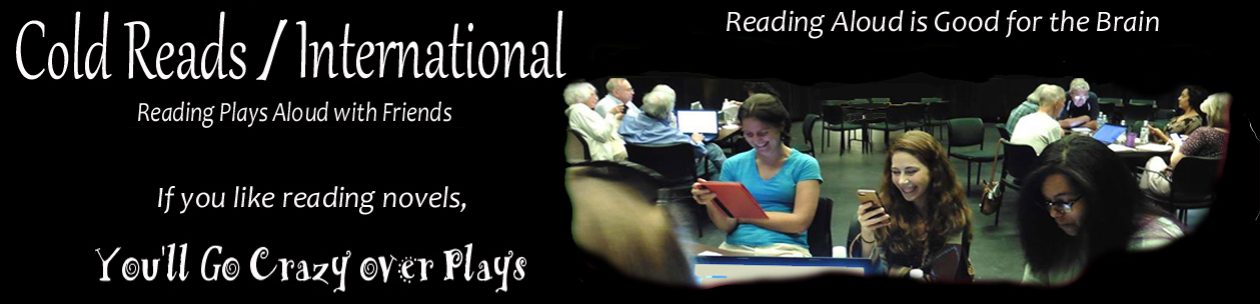
On Sunday afternoon, October 12, I was invited to present Cold Reads to members of the Metrolina Theatre Association. Because I tend to ramble, I scripted the first half of of my presentation as follows, amended to suit a general (non-theatre) audience, with cues to prompt responses during the talkback.
I authorize and encourage (beg) anyone to use it as a guide to pitch the practice.
Intro
I’m here today to pitch Cold Reads, an interactive pastime I’ve been preaching since around the turn of the century—specifically, reading plays out loud with other people. It hasn’t been easy.
People don’t read plays.
Statistically, three out of four adult Americans reads at least one book a year. Fewer than one in a thousand ever reads a play. Why is that?
Oh. “Plays are written for the stage!”
Right. But who goes to the theatre?
Plays on stage are Spectacle—the last of Aristotle’s elements of drama. Plot and character, theme, language, and rhythm are all in the playwright’s words. Unless we read plays, we’re dramatically illiterate.
Raise your hands if you’ve read a play aloud with others since high school Shakespeare.
[Comments?]
Today we’re going to explore the all to many reasons people don’t read plays, and then debunk these lame excuses with as many reasons we’ll be better people—and the world will be a better place—when cold reading is an international obsession. But first, let’s play the game.
Cold Reading is a game, after all—“a structured form of play, usually undertaken for enjoyment and sometimes used as an educational tool.” A play is play by definition. Think about it. We read the lines in turn, like playing cards; we make believe we’re other people, discover a story line by line—and interact along the way. It’s like charades with words, or Pictionary. Poker. Dungeons and Dragons. Gold. Any game we play with others.
We don’t “act.” Acting happens after years of training and weeks of hard work. We may play around with the words as we discover who we are, but we’re just reading—like a novel. Think of cold reads as a book club, only we read plays aloud, together, sharing the dramatic art; novels are a solitary, silent pastime.
And we discuss them as we go, not days days or weeks later.
And what are plays but novels with no narrator? Both tell stories about people interacting with the world. A play is just as rich in plot and character, language, moral theme; they’re just as entertaining, funny, sad, enlightening, emotional; only plays consist exclusively of people talking to each other—tailor-made for quality time with friends. Think about that.
Plays are Drama, novels are Prose. Together with Poetry, they form the 3-legged stool of literary art. Most of what we read these days is prose; poetry is rarely read but omnipresent in our ears in song (the lyrics), but unless we go to the theatre (and we don’t), We Don’t Know Drama.
Movies, right. That’s another whole ball game, Movies are drama, true, but they’re not live theatre. Are they literature? Focus is on the picture, not the words. In any case, the rule applies—we don’t read film scripts either.
Back to the game.
The Icebreaker
The first step in a cold read is downloading a play. Cold Reads is a computer game. Ironic, no? Open your devices and go to http://www.coldreads.com.
One reason people didn’t read plays in the past was the trouble and expense of finding scripts for a group of readers. These days all the classics are on line, from Aeschylus Ibsen—just Google the titles. Modern plays are hard to find; they’re copyrighted, but many are available to readers. Browse the Catalog on the Cold Reads blog. Or visit 10-Minute Plays.com.
Everybody on the site?
This is what my life’s been all about for well over a decade, and it’s still a work in progress.
Note the name: Cold Reads/International—CR/I. This site’s for everybody everywhere.
Now scroll down the scroll. That’s cold reads in a nutshell.
[Take a moment.]
If you “Click to Continue” you’ll get more of the same, with more detail.
Scroll back up to the top of the page, and click on the blue “Break the Ice” link in the right sidebar to open the Short Shorts post.
Now scroll down to 10-Minute Plays, and click on a playwright; then click on a play. Simple, yes?
This list is just a sample. Google 10-minute plays on line for many more. Look for those in PDF or DOC format, bypass those that ask for membership, and add those you find worthy to the list.
Playwrights, add your own, with permission to publish.
Everybody got a play?
Okay. Step Two is casting. Everybody pick a partner.
Now decide which play you’re going to read and who plays whom. If you’re a woman with a two-man play, be a man. Nor does cast size matter. If your play has more than two characters, be two people. If your partner starts talking to him (or her) self, take over one of his (or her) roles.
Anybody have more than four?
A word or two before we read.
A big part of the game is ad lib interaction. Readers are encouraged to interrupt at any time to comment, question, recap, reflect—talk about whatever comes to mind. “This makes me think of of blah-blah-blah…” Let this lead to conversation. At some point a reader speaks the next line, and the play continues.
Sometimes we ad lib more than we read, and time runs out. No problem. We either schedule another time to finish or find out how it ends on our own. That happens a lot with full-length plays; today you’ll have about twenty minutes. One nuance of the cold reads game is balancing script and ad lib gab.
Think of a 10-minute play as a parlor game—an ice-breaker—great for any party or event. Simple, quick, and easy, fun, engaging, entertaining—and free.
Everybody ready?
A note on stage directions. Either reader can read those that describe action. Ignore the short and simple ones, like “(Happily)” or “(To John).”
Any questions?
[Feedback]
Now take a few seconds to clear your mind. Close your eyes. Deep breath. Relax. It’s Play Time. Mother, May I?, Cowboys and Indians, Dungeons and Dragons, Trivial Pursuit—you name it. Politics. The Game of Life!
Feedback
Who all finished the play?
Who read straight through to the end and had to fill time?
What do you think? Was it fun? Were you entertained? Enlightened? Moved to tears?
Questions? Comments?
[Field Q&A]
The Pitch
[Distribute handouts]
Here’s a handout. Page One is for you to keep. It’s an agenda for the afternoon, with links to pertinent web sites and a nutshell overview of the rules of the game.
Basically, the rules are those for Theatre Games developed by Viola Spolin, like “share the scene,” “go with the flow,” “play in the moment,” “give and take,” “listen and learn,” “open your mind” “play fair”—rules that apply to all to all interactive games, up to and including the Game of Life. Human Life is the ultimate improv. These general rules emphasize the respect, consideration, and support each reader shows and expects from the group in the sharing of roles and expression of thoughts and opinions.
Rules for cold reads are more specific. We read aloud with others. We don’t rehearse. Ideally, we pick a play we’ve never read (or seen)—a true “cold” read—although old chestnuts can be fun. And we don’t perform—that’s readers theatre. We read. Everybody reads.
Other rules are practical guidelines. An optimal read, for instance, consists of eight or ten readers, although two or three works fine—especially for small cast plays. More than a dozen, we split into groups.
And unless the play has exactly as many readers as there are characters with significant roles, it’s only fair to switch off, swap around—double up for crowd scenes.
Likewise, the balance of male and female roles, their age and type, very rarely match those of the group, so we disregard these traits.
This is not to say it’s wrong to cast to type, invite one reader for each role, or read a familiar play straight through, no-stop. These guidelines assume two or three to a dozen readers and an unfamiliar play. More than and dozen and we split into groups.
Typically, a read begins when someone (anyone) takes the bull by the horns and reads the name of the play, the title, the dramatis personae, and the stage directions. A second person reads the first line of dialog and claims that role; a third does likewise with the second line. As other characters appear, other readers do the same. After a while (end of a scene), a reader voluntarily yields a role to one who hasn’t read—or one who hasn’t jumps on a line and takes it. If readers are reluctant, others in the group may (gently) prod; likewise those who dominate are (politely) restrained. The goal is to balance the read.
Anyone can interject at any time to give up (or take over) a role or start a conversaation. Someone else decides when it’s time to read the next line and press on. If time runs out (as often happens), either a wrap-up read is scheduled or the game is over and we find out how it ends on our own.
CR/I
Details and variations on these guidelines are presented in the blog. Let’s take a minute to revisit http://www.coldreads.wordpress.com.
Everybody on the Home page?
If you’re using a tablet or a laptop, below the banner, you see seven tabs. Hover over them to reveal drop-down subheads. Click on “How It Happens.”
If you’re on your phone, click on the parallel bars to the right of the green Search button to bring up the Menu. Note the green-highlighted HOME. That’s the page we’re on, a major heading, with all its sub-heads. Scroll down past Why Read Plays? and its subheads and click on How it Happens.
Is everybody on the page?
Scroll down. Most of what we’ve talked about so far is outlined on this page, with links to posts with more detail.
Note the other menu options (phones scroll back to the top, open the menu again—the parallel bars—and scroll down). “Why Read Plays?” “Catalog,” “Feedback,” “Join Up,” and Blog.”
The Catalog lists links to all 200+ full length plays CR/Charlotte has read—and a few we haven’t—since 2014, when we went digital and I created this site. Anyone can download plays for free, and a lot of people do, over 200, mostly from other countries. What else is new?
Feedback is for testimonials and comments on the site from visitors and followers. These are very few. You can help when you get home by submitting a review of this event.
Join Up is for those who would be Editors or Authors on the blog, form groups, connect with other readers, share scripts and occasions, spread the word. So far, counting me, we’re eleven, and I’m the only one who posts.
The Blog is where the plays are posted, by Category, along with rare (so far) and random posts about Cold Reads/Charlotte and other rants by (so far only) me.
These four major pages are complete (if overwritten), as are most of the links to related posts. Why Read Plays? Is another story.
Which is where we’re going next.
I beg of you, when you have time, to visit, follow, download (or upload) plays, post comments, and hopefully join—maybe even help me edit, write the book—because I know when the time comes, once the ball starts rolling, this pleasureful and worth-while pastime will be the thing to do.
Granted, it’s a work in progress—as you’ll see when you muddle through Why Read Plays? That’s why I need help. It’s a damn good cause.
There are even ways to make it pay. The book itself—if and when I write it—might take off: How Reading Plays Aloud Can Save the World. Once it does, and the multitudes start reading plays, enterprising actors (directors, playwrights, teachers) will earn $50-100 an hour moderating cold reads for the rich and ignorant, who will start going to the theatre, take an acting class, write a play—or give lots of money.
Meanwhile, some university will introduce, feature, and require cold reading classes—a combination of drama literature, reading comprehension, discussion and debate, voice and diction, and oral interpretation, just to name a few. Imagine a class in English or American lit in which, instead reading a book at home and discussing it in class (or taking notes on a lecture), you read the words aloud with others and shared thoughts along the way. It won’t be long before drama is right up there with poetry and prose.
Now imagine public school, from third grade on, pupils reading plays aloud as often as they read books and poems to themselves. There’s another market: writing plays for kids.
Imagine libraries embracing cold reads for adult, and since most people “don’t have time” for full length plays, playwrights will furnish more one acts—there are far too few of these.
What I can’t bear to imagine is some giant corporation catching on and licensing franchise studios for profit. Cold reads are FREE.
The problem is, by the time all this takes place, I’ll be long gone, my mission unaccomplished.
The problem is my mind is slipping. In grad school I wrote A+ papers without notes the night before they were due. These days I get distracted, write the same things over and over with different phrasings, better words, but all disorganized, a jumble. Which is foremost: “Fun and Games” or “Save the World?”
Seriously, I need collaborators. My super-objective for this event, aside from each of you reading with friends, who will read with friends—is to find people who truly believe cold reads has a bright (and necessary) future—or who knows those who might—who’ll join me, help me, take the reins, and make it happen.
I can’t even finish a Ted Talk.
Questions? Comments?
[Discussion]
We’re going to take a break in a minute, but first, look at Page Two of the handout. This is the structure for the Cold Reads argument, under Why Read Plays?, starting with all the reasons people don’t, and followed by all the reasons it’s really quite the thing to do—for ourselves, our relationships, our heritage, and out future.
Take a few minutes to think, and jot down what comes to mind. Why don’t you read plays? Why don’t the masses? What’s in it for you, your relationships, our culture, and the world? We’ll talk about them after we break, and I’ll compile and post them, along with the text of this presentation, on the Cold Reads blog.
[TAKE TEN MINUTES, THEN]
Break
Brainstorm
One basic rule of any game is “play fair.” Specifically, everyone gets to have their say. Reticent players are urged to speak, nobody hogs the show. Okay?
So. Why Not?
First question, why don’t you read cold? Or if you ever do, why not more often?
Never even thought about it. (Why not? Press this.)
No time. All the other things I do.
Now why don’t the masses?
Ignorance, No time. No interest. No friends who read (they’d think I was crazy). Inhibition. Poor reader. No actor.
Cultural attitudes: Religion, Politics, The American Way
Fear of confronting the human condition (the wholly human art)
So much for Why Not? Now let’s think of all the reasons for indulging in this game, beginning with ourselves. What do we get out of it?
Personal Enrichment
Besides being simple, easy, entertaining and enlightening fun for free
Quickens the brain, triggers imagination, inner child
Improves reading and speaking skills
Re-awakens interest in dramatic art, itself a treasure trove of intellectual and emotional enlightenment and gratification.
Possible remuneration (moderating)
Social Interaction
Comparisons to other games (but nobody loses), storytelling, book clubs, barhopping…
It’s fun (and good) to be with people
Cultural Heritage
Religion & politics. 2000 years (from Greeks to Rome, to church, to Shakespeare
Modern plays known only to theatergoers, although some very potent (Hamilton, Angels in America
Salvation
Plays are good for the human soul. Plays teach us who we’ve been and who we are. Reading together reinforces our common humanity; if it becomes a game all people play, it might just save the world.
Ode to Live Theatre, the Church of Humankind
Seeing vs. reading (Aristotle)
Everybody acts
Reading plays sends people to the theatre, true salvation
Possibilities
Venues—anywhere with comfy chairs and not much noise.
Readers—anyone, from family and friends to total strangers. Join (or start) a group
Occasions—coffee break to dinner party, rainy afternoon, weekend retreat, conclave, national convention
Special Events—Shakespeare night at Big Ben’s Pub, “read a monologue for beer.” (karaoke);
School curricula, grade school through college; library programs; theatre previews (read one act, come back and see the rest); nursing home and summer camp activities—even corporate training programs. An international alliance of Cold Reads salons, with professional coach/moderators.
Cold Reads/Charlotte
How many already members?
Anyone can join, post pertinent comments, and create events.
No mandatory attendance. Come when you feel like reading.
Active membership in both CR/I and CR/Charlotte is important. It’s one thing to enjoy a read with friends—that’s great. It’s something else to share it with the world. Even if you don’t create Facebook events, post a post mortem review, so the world will know we’re reading.
My original expectation was that people would start doing it on their own.
Questionnaire
Answers will be compiled and posted, along with the text of this presentation, in the Cold Reads blog.
Read Some More
Break into groups of three or four to eight.
Now go back to the web site, select Catalog of Plays, and pick a play with a green title. (Those in red are copyrighted, and require passwords.)
We won’t have time to finish. Either find another time to meet or find out how it ends with family and friends (or by yourself).
Wrap
I’d have thought by now some enterprising visionary or benevolent non-profit would have picked up on the idea, taken the reins, edited my tortured prose, published the book, produced a documentary—or better yet, a hour-long weekly series on BBC, hosted by a prominent actor or director who gathers a group of celebrity friends (or strangers, college kids, old folks, convention, church group) to read and ramble on play, while multitudes of groups at home—the viewing audience—download the play and follow along. When the hour’s up, the host encourages the audience to continue on to the end.
The time will come.
And when it does. we’ll all be better people.
 Cold Reads/International