
Theater history tells us that world’s first playwright after the fall of Rome (500 years after, to be precise, at the end of the 10th Century) was a German nun, Hrotsvitha, who penned six comedies in Latin, based on Terrence, with Christian themes.
Three hundred years later, as the Renaissance began, the next plays appear, first in Italy, in Latin, then Italian; then in France, Spain, the HRE; later still (16th Century) in England: Medwall, Heywood, Lily, Kyd, Marlowe, Shakespeare, Jonson, Beaumont and Fletcher, Ford, Dryden (to name a few).
All men.
Then came the Restoration of the libertine Charles II (1660), and with him, Aphra Behn—the first woman ever to earn her living as a playwright,
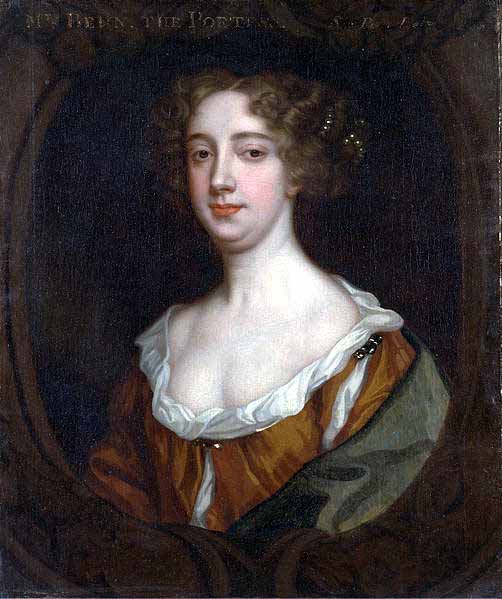
The story of her life would make a great stage play, especially as told by Montague in her 30-page Preface to the 1915 edition of Behn’s works (click here). Her version reads like Charlotte Temple, from well-to-do in England to impoverished in Senegal, to marriage and a life at court, a spy in the Netherlands, imprisoned for debt, employed as a theatre scribe, then a celebrated playwright before illness, more poverty, and death at forty-nine.
The Wiki version (click here) is much shorter, and debunks much of the romance.
Shorter still (for those who don’t want to click):
She was born in 1640, two years before the Civil Wars, and grew up during Cromwell’s Commonwealth. Her father, a prosperous Canterbury barber, Church of England (if not Catholic), with her and her mother sailed for Senegal to escape the Roundheads. He died en route, but they remained in Senegal until the 1660 Restoration. Her story “Oroonoko” may be based on a slave she knew there.
Back in England, at twenty-four, in London, she married Johan Behn, a prominent Dutch immigrant connected with the court of Charles II, and for several years she consorted with the aristocracy; King Charles himself reportedly admired her charm and wit, and when Behn died (or left her, destitute), he sent persuaded her to use her husband’s connections to spy for him in the Antwerp during the Second Anglo-Dutch War (1665-67), with promises of rewards.
But her mission failed, England lost the war, and she was never paid or compensated for the funds she’d borrowed to betray her friends. Instead, she was sued by the loan shark Edward Butler and may have spent time in debtors prison.
Forced to work, she became a scribe for The King’s and The Duke’s theatre companies, and within two years had written and staged her own first play, The Forced Marriage, followed by eighteen more, including The Rover (1677) and its sequel (1681). Only her good friend John Dryden was more prolific, more than cohorts and companions Thomas Middleton, John Hoyle, Thomas Otway and Edward Ravenscroft.
Ill health plagued her last four years until, in 1889, writing till she couldn’t hold a pen, she died.
Intrigued? Go back and click.
 Cold Reads/International